How do you market something that hasn't changed in a century?
In Matosinhos, a sardine cannery that nearly closed has turned slow, hand-made production into its strongest selling point. NURI's tins look almost exactly as they always have. The business behind them does not.
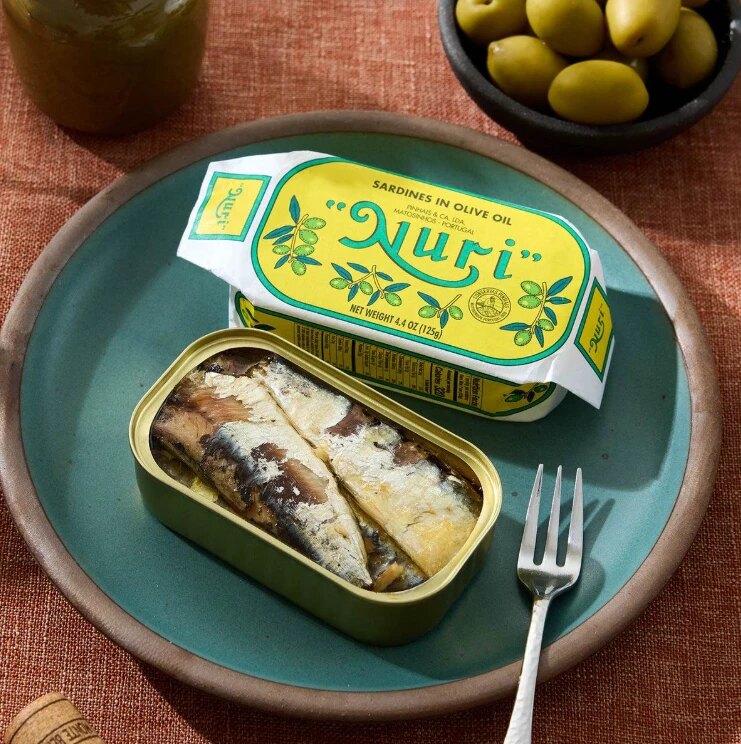
Image: NURI / Conservas Pinhais
Matosinhos, just north of Porto, was once one of the great sardine ports of the world, with 54 canneries working along its streets. Three are left. One of them, Conservas Pinhais, now sells tickets. Visitors walk through a factory founded in 1920, watch fish being cleaned and packed by hand, taste the result in the factory café and finish by wrapping a tin in paper themselves, which is harder than it looks.
Most food manufacturers spend heavily on making production faster and less dependent on people. Pinhais charges admission to show how much of its work is still done by hand. That reversal sits at the heart of how it sells NURI, the brand that carries its sardines around the world.
NURI tins are easy to spot: bright, plainly old-fashioned, each one wrapped in printed paper that looks lifted from a mid-century grocer's shelf. The company's own material dates the brand's international sales to 1935, and the look has changed little since.
Behind the wrapper is a process the company and its retailers describe in 37 steps. Fish are bought at the Matosinhos market, cleaned, pre-cooked, laid in the tin by hand, sealed, sterilised and wrapped. Machines handle a few stages, such as sterilisation; people do most of the rest.
That is what makes the brand unusually easy to explain. Almost any packet can claim to be made with care. At Pinhais a visitor can see what the care consists of, how long it takes and who is doing it. Hand production is not proof of a better sardine on its own; that depends on the fish, the oil, hygiene and the finished product. But it gives NURI a story that is checkable, which is more than most food marketing can say.
The heritage was close to ending. In 2016 Pinhais faced bankruptcy, and it was rescued by Jakob Glatz, head of the Vienna-based Glatz group, whose family had a long relationship with the cannery and the NURI brand. The new owner kept the methods and the look. What changed was the business built around them.
The product stayed the same. The ways of meeting it multiplied.
The factory became a visitor attraction, with guided tours, a museum area, tastings and the Can-Tin Café. A NURI Reserva line borrows an idea from wine: tins are packed in a stated year and sold as vintage editions, on the brand's argument that sardines in oil can keep improving for up to a decade if stored cool and dark. A shopper might now meet NURI in a delicatessen, on a restaurant menu, on a holiday in Porto or as a gift with a year printed on it. Each route shifts the question from what a tin of sardines costs to why one tin might be worth more than another.
Selling hand work as heritage brings obligations. A factory that puts its staff on show depends on keeping skilled people, training new ones and paying them well enough to stay, and a brand that leans on craft has to honour it off camera as well as on the tour. It also depends on the sardine. The Iberian stock spent years at low levels, and Portugal and Spain cut catches hard in the late 2010s. Under a joint management plan the stock has been recovering and quotas have risen again, a reminder that a cannery built on fresh local fish is only as secure as the fishery that supplies it each morning.
Public brand material does not reveal margins or how much the tours earn, so it is hard to say how much of the revival comes from tradition and how much from good management. But the direction is clear. Pinhais did not survive by modernising the tin. It survived by modernising everything around it, and by inviting people in to watch the old way still working.
Fresh Catch · The SALT. newsletter
Enjoyed this story? There's more where that came from.
Food, oceans, people and ideas. The most interesting stories from SALT., delivered to your inbox.
Free to read. Free to subscribe. Unsubscribe anytime. Privacy
About this story · 12 sources
Sources
- PORTUS Online, Pinhais: 100 years of great resilience in the fish preserve industry of Matosinhos
- PORTUS Online, author profile of Jakob Glatz
- Matosinhos tourism presentation (UN SDGs platform)
- Culinary Backstreets, Sardine City tour
- Visit Porto and North, Visit to the Conservas Pinhais factory
- Porto Secret Spots, Conservas Pinhais factory tour
- Fine & Wild, NURI production notes
- Sezamo, NURI sardines in olive oil product listing
- Ugly Pantry, Does ageing canned sardines make a difference?
- Worldcrunch, The economic lessons of Portuguese sardines
- ICES, evaluation of the Portugal–Spain management and recovery plan for Iberian sardine
- The Fishing Daily, Spanish sardine season ends with highest catch in recent years
Spotted an error? Tell us. We correct the record openly.