How did a fictional captain become the face of frozen fish?
Birds Eye invented him in 1967, killed him off in 1971, brought him back in 1974 and has recast him ever since. Captain Birds Eye's long career shows what a mascot can do for frozen fish, and what it can't.
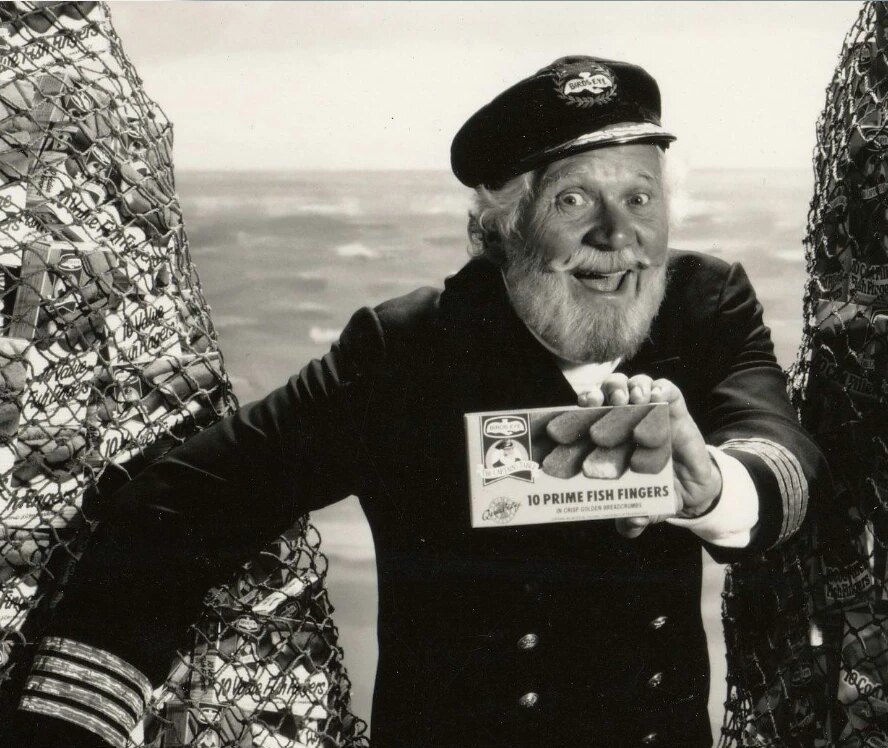
Image: Birds Eye
In 1971 Birds Eye killed its captain. The bearded sailor who had been selling fish fingers on British television for four years was written out of the advertising. Three years later, in 1974, the company brought him back. A familiar face, it turned out, was worth more than a fresh start.
That episode set the pattern for the next half-century. Birds Eye has dropped, recast and revived the Captain several times, and each time it has discovered the same thing: you can invent a character, but once a country has grown up with him, you no longer fully control him.
The product came first. Birds Eye developed its fish fingers at its factory in Great Yarmouth, test-marketed them in the south of England and launched them in 1955. They offered something fresh fish could not: identical portions, no bones, no smell in the kitchen and a shelf life measured in months. Freezing took fish far beyond the ports and seasons that had always limited it, and turned it into an everyday family meal.
What a box in a freezer cannot do is win trust. Shoppers buying frozen fish cannot look the catch in the eye the way they can at a fishmonger's counter. They go on packaging, price, past experience and their faith in the company. The Captain, introduced in 1967 and played by the actor John Hewer, gave that faith a face. White beard, peaked cap, a calm manner around children: he looked like someone who knew boats and could be trusted with tea.
He was never evidence of anything. A mascot cannot vouch for a fishery or a factory. But he made a frozen product feel like it came from somewhere, and for a generation of British children the face and the fish finger were the same thing.
Hewer played the role, with that one interruption, until 1998. His replacement was a younger captain with designer stubble. Viewers did not take to him, and the character slipped out of the advertising altogether. Birds Eye kept selling fish fingers, but without its best-known asset, and by the mid-2010s the brand was in trouble.
According to the case Birds Eye and its agency later submitted to the Institute of Practitioners in Advertising, fish fingers had suffered five years of significant decline before 2017, with falling sales, fewer households buying and weaker perceptions of quality. Own-label competition was fierce, and convenience was no longer much of a reason to pay for a brand. The company responded by abandoning a single master-brand message in favour of a handful of pillar brands, each with its own focus. Fish fingers was one of them, and the Captain, absent for around a decade, was the obvious tool.
In January 2018 Birds Eye introduced the Italian actor Riccardo Acerbi, then 56, as a leaner, quieter Captain with a salt-and-pepper beard and no lines to speak. The campaign, created by Grey London and backed by £8m of media across television, online video and social channels, pitched fish fingers as simple food made from real fish, with no apology for being frozen.
The numbers in the IPA case are unusually concrete. Over three years, value sales of Birds Eye Fish Fingers rose 18%, from £88m to £104m, beating a £100m target, and the decline in household penetration was reversed. The case attributes £1.77m of profit to the campaign's short-term effects alone. It is the company's own account of its own work, and the recovery also involved new product priorities and heavier media spending, so not every extra pound belongs to the man in the cap. It is still rare evidence that a revived mascot can pay its way.
In March 2019 Birds Eye went further. It retired its premium Inspirations fish range and moved the products under the Captain Birds Eye name, after research suggested Inspirations was suffering from his absence. A character created to sell children's teas was now being trusted to sell the premium end of the freezer.
The lesson is not that nostalgia sells. It is that a well-loved character is a promise, and frozen fish is a category that has to keep it. The Captain only works because the product behind him delivers: consistent, affordable white fish from fisheries that buyers and certifiers can scrutinise, processed fast enough to lock in quality. That is a genuine strength of the frozen supply chain, and one the industry undersells.
The mascot is the door. The fish has to be worth walking through it for. On that basis, after nearly sixty years, the Captain has earned his place at the table.
Fresh Catch · The SALT. newsletter
Enjoyed this story? There's more where that came from.
Food, oceans, people and ideas. The most interesting stories from SALT., delivered to your inbox.
Free to read. Free to subscribe. Unsubscribe anytime. Privacy
About this story · 10 sources
Sources
- BAFTA, In memory of John Hewer
- The TV Room Showreel, John Hewer (Captain Birds Eye, 1967–1971 and 1974–1998)
- Great Yarmouth Mercury, Great Yarmouth the birthplace of the Birds Eye fish finger
- The Drum, Birds Eye casts younger silver fox in the role of the Captain (January 2018)
- Undercurrent News, Birds Eye launches 2018 media campaign with new rugged Captain
- The Grocer, Captain Birds Eye gets younger, more rugged look in new ad push
- IPA, The return of the Captain: how reinventing an icon grew Birds Eye Fish Fingers
- IntraFish, How the Captain rescued Birds Eye fish fingers
- Food Manufacture, Birds Eye folds Inspirations into Captain brand (March 2019)
- Marketing Week, Why Birds Eye decided to kill its Inspirations fish range
Spotted an error? Tell us. We correct the record openly.