Why does your fish travel halfway around the world?
A pollock caught off Russia's Pacific coast can be filleted in China and breaded in Europe. It sounds absurd until you look at how the business of fish actually works.
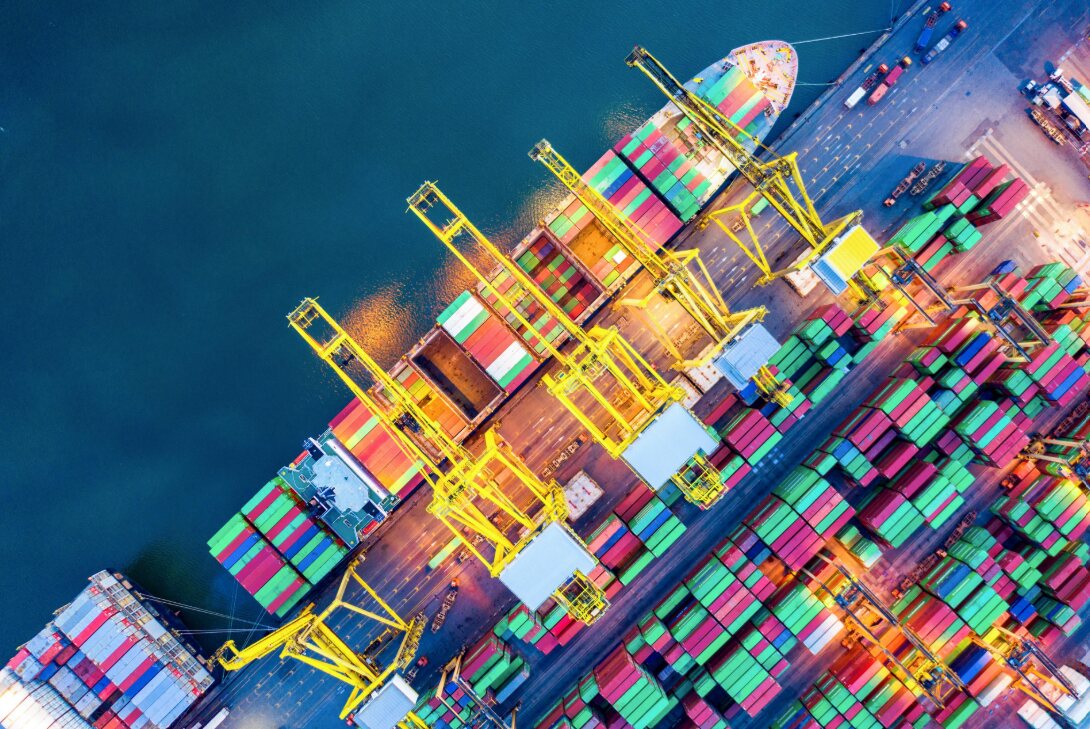
Around 600,000 tonnes. That, according to FAO GLOBEFISH, is how much frozen Alaska pollock China imported in 2025, roughly 50,000 tonnes more than the year before, with Russia supplying more than 95% of it. Much of that fish was caught in the North Pacific, frozen, and shipped to factories on China's coast. A good share of what comes out of those factories (fillets, portions, blocks for breading) is then shipped on again, to Europe and other markets.
On a map, the route looks perverse. In a spreadsheet it makes sense, because catching fish, processing fish and selling fish are three separate businesses, and each one goes where it can be done best.
Fresh fish has a commercial life measured in days. Fish frozen hard soon after capture can sit in a cold store for months and cross oceans in reefer containers without losing its value as raw material. Much North Pacific pollock is frozen on board, either whole or headed and gutted, which turns a perishable catch into something closer to a commodity. The cold chain is as much a part of the industry's infrastructure as the trawlers.
Once the fish is frozen, the question becomes where to thaw, fillet, trim, portion and refreeze it. That work is labour-intensive and exacting: buyers want boneless pieces of a set weight and size, or blocks cut to the dimensions of a breading line. Over several decades China built a reprocessing industry around exactly that: large plants, skilled filleting crews, and the volume to keep lines running all year. A study in Science reported by Dialogue Earth found that most of the seafood China imports is processed and re-exported rather than eaten there. An earlier TRAFFIC analysis found that pollock and cod made up between 71% and 83% of the raw material entering China's fish-processing trade for salmon, whitefish and tuna in 2004–2007.
Not every fish makes the trip. A lot of seafood is processed close to where it is landed, Russia has been investing in on-board and onshore filleting so it can sell more finished product directly, and companies have spent years weighing overseas processing against automation and tighter control of their own production. The Chinese route survives where its combination of skills, scale and price still wins.
Politics redraws the map too. The United States banned direct imports of Russian seafood in March 2022, after the invasion of Ukraine. Russian fish kept arriving through processors in third countries, so in December 2023 an executive order extended the ban to Russian-origin salmon, cod, pollock and crab wherever it had been processed. China itself raised its import duty on frozen Alaska pollock from 2% to 5% from January 2025. Every change of this kind shifts costs along the chain, and the effect often lands, in the end, on the price a fishing company is paid for its catch.
Supply is the other moving part. GLOBEFISH reported in May 2026 that the Northeast Arctic cod quota had been cut to its lowest level since 1991 and that pollock quotas had been trimmed in both Russia and the US. Cod trade has fallen and groundfish prices have climbed, and GLOBEFISH expects them to stay high, pushing buyers to look for cheaper whitefish and to rethink products and contracts.
For the climate, the distance matters less than most people assume. Life-cycle studies of seafood tend to find that the fishing itself and the mode of transport matter far more than the number of kilometres, and that container shipping is the least carbon-intensive way to move fish. Air freight is the problem: in a Matís life-cycle assessment of fresh Icelandic cod loins, flying the product accounted for over 60% of the chain's emissions, while shipping it by sea to the UK produced less CO2 than trucking it around within the UK. SINTEF's work on seafood footprints reached the same conclusion from the other direction: shifting from fresh to frozen, and processing before export, are among the biggest gains on offer.
The harder questions are about value and visibility. When fish is caught under one flag, processed under another and sold under a third, the jobs and margins are split across borders, and producing regions become exposed to decisions taken a long way away. Traceability gets harder at every change of hands, which is why customs rules, catch documentation and the origin on a label matter so much. A long supply chain is not a sign of bad practice, but it does require buyers to demand paperwork that follows the fish all the way back to the vessel.
Global processing chains are one of the reasons whitefish is affordable at all. They turn a wild catch from remote, cold seas into consistent, safe products for millions of households, and they keep fishing fleets in business when local processing cannot absorb the volumes. The industry's job is to keep those chains honest (legal catch, decent working conditions in the plants, documents that stand up) rather than pretend that fish should only ever be eaten near where it was caught.
Fresh Catch · The SALT. newsletter
Enjoyed this story? There's more where that came from.
Food, oceans, people and ideas. The most interesting stories from SALT., delivered to your inbox.
Free to read. Free to subscribe. Unsubscribe anytime. Privacy
About this story · 7 sources
Sources
- FAO GLOBEFISH, Falling cod trade lifts prices across groundfish markets (May 2026)
- FAO GLOBEFISH, China announces duties for 2025
- Dialogue Earth, China re-exports most of the seafood it imports
- TRAFFIC, Understanding China's fish trade
- Alaska Beacon, Executive order bars imports of Russian fish that is processed in other countries (Dec 2023)
- SINTEF, Carbon footprint of seafood products (2009)
- Matís, Life Cycle Assessment on fresh Icelandic cod loins
Spotted an error? Tell us. We correct the record openly.