Can AI tell when a fish is hungry?
Cameras, sonar and machine learning are getting good at reading a salmon cage. The best results so far come from systems that know their limits, and from farmers who still check their work.
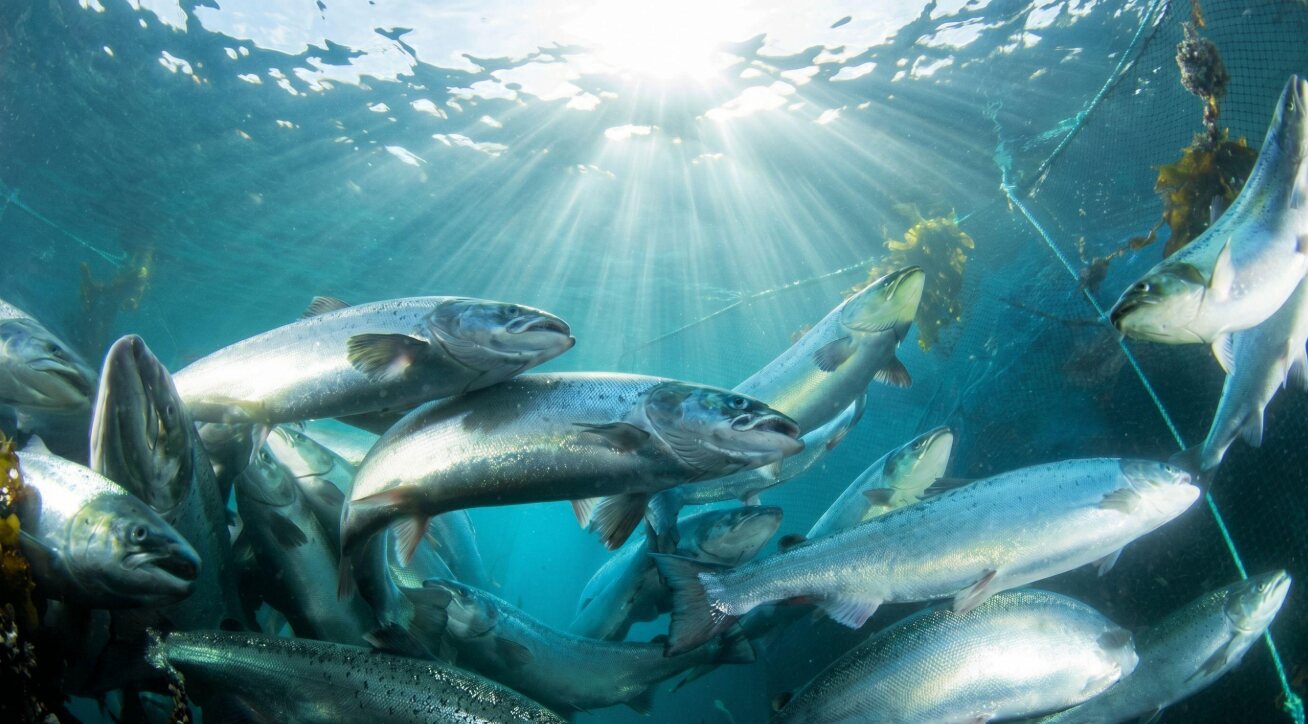
Not directly. No sensor can measure appetite. What cameras, echo sounders and machine-learning models can do is read the signs of feeding (pellets sinking uneaten, fish rising to the surface, a shoal tightening or scattering) and turn them into decisions about when to start and stop a meal. On a salmon farm that matters a great deal. Feed accounts for around half the cost of producing a farmed salmon in Norway, according to Nofima, and every pellet that drifts through the net is money lost and extra nutrient load around the farm.
The useful question is therefore narrower: how reliably do those signs track what the fish actually want, and what happens when conditions change?
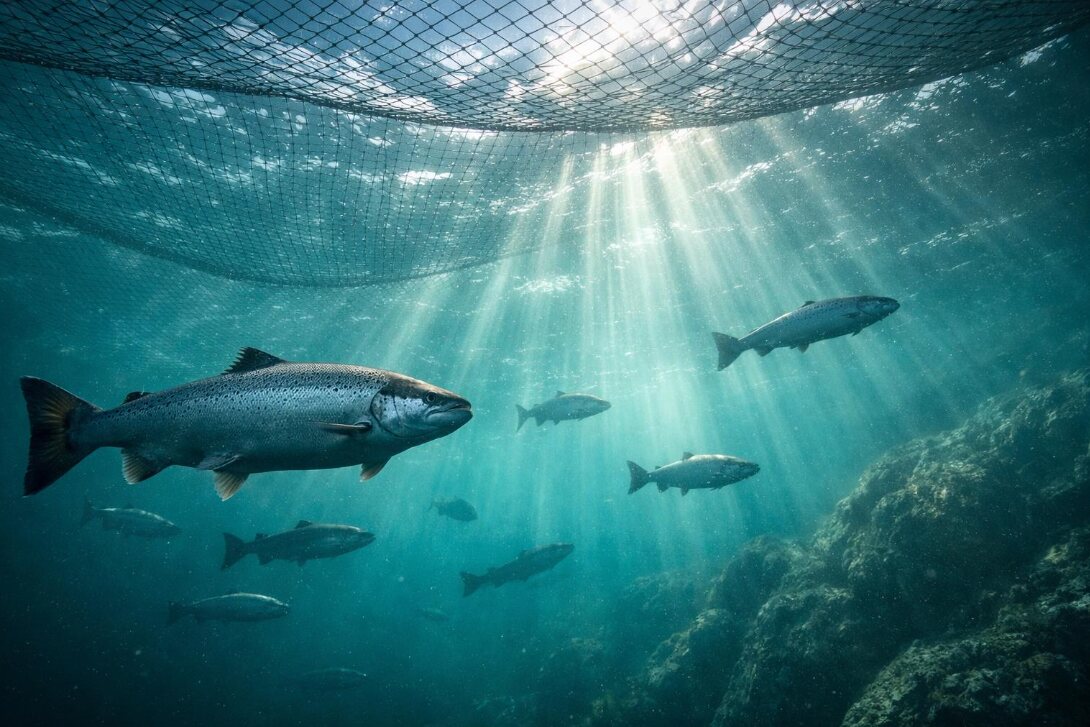
Researchers from Norway's Institute of Marine Research and partners have been testing a method called echofeeding, in which an upward-facing echo sounder estimates how much fish biomass is gathered in the feeding zone and software ends the meal when that biomass drops away. Earlier trials at a coastal site where the water column was well mixed found it cut waste feed while keeping growth on track. Norwegian firms such as CageEye have built commercial systems on the same acoustic principle.
The follow-up, published in Aquacultural Engineering in October 2025, ran echofeeding at commercial scale for eight months in a fjord, where temperature and salinity change sharply with depth and season. It was compared with a control group fed by conventional pellet detection, which stops feeding when cameras spot pellets falling past the fish.
For the first three months after the fish went to sea in August, the two groups grew equally well and converted feed equally efficiently. Then, in late November, a strong layer of fresher, colder water settled at the surface, below 5°C. The salmon would not come up through it to feed, the echo sounder read that as a lack of appetite, and the echofed fish were underfed. Lowering the depth that triggered feeding fixed most of it: the fish ate more and caught up with the control group, at a gentler feeding intensity. In early spring the opposite problem appeared. Warming surface water drew the salmon upwards whether they were feeding or not, and the system struggled to tell the two apart. Both groups also caught salmonid alphavirus over the winter, which suppressed appetite and brought harvest forward.
The authors draw practical conclusions rather than a verdict. Echofeeding has to allow for a stratified, seasonal environment; the echo signal during feeding fell as the fish grew, which could be used to fine-tune when meals stop; and pellet detection held up well as conditions changed. Salmon, they found, trade off water temperature against hunger. A system that only measures position will misread that trade-off unless it is told about the water too.
Camera-based systems have their own strengths and limits. One of 2025's more practical advances was YOLO-feed, described in the journal Aquaculture: a lightweight object-detection model built on YOLOv8 that spots feed pellets in real time on an ordinary computer processor rather than specialist hardware. Its developers report a precision of 0.966 with fewer than a million parameters, and used it to estimate how much individual fish in a school were eating, with around 90% accuracy. They have published the code openly.
That is a genuine step towards cheap, deployable feed monitoring. But a pellet detector is one component, and accuracy on test footage is not the same as better growth, welfare or feed conversion over a production cycle. Real cages are messier than datasets: fouled lenses, turbid water, strong currents, changing light, and models trained on one site or species that perform worse on another. The evaluations that matter compare a technology against good conventional practice over a full cycle and report feed use, growth, conversion, waste and cost.
The same tools are starting to reach beyond feeding. A 2025 study in Aquaculture Science and Management ran a machine-vision algorithm on the feed cameras in every pen at two Scottish salmon farms, producing a group activity score from fish numbers, speed and shoal cohesion. When gill health problems hit both farms in summer 2023, they showed up in the behaviour data. Two farms is a small sample, and behaviour changes rarely have a single cause (a fish that stops feeding may be full, stressed, short of oxygen or ill), but as an early warning that prompts someone to go and look, it is promising.
What these studies have in common is that the technology works best as an extension of the farmer's own eyes: watching every pen, through the night and in poor visibility, and flagging when something has changed. The echofeeding trial is valuable precisely because it records where the system went wrong and how it was corrected, which is the kind of evidence the industry needs more of.
That is the right standard for farm technology. Not an autonomous cage, but systems that combine several signals (acoustics, cameras, oxygen and temperature), make their uncertainty visible, and help staff waste less feed and spot disease sooner. Done that way, they make farmed salmon cheaper to produce and easier to defend, and that is a better pitch than any claim to read a fish's mind.
Fresh Catch · The SALT. newsletter
Enjoyed this story? There's more where that came from.
Food, oceans, people and ideas. The most interesting stories from SALT., delivered to your inbox.
Free to read. Free to subscribe. Unsubscribe anytime. Privacy
About this story · 8 sources
Sources
- Aquacultural Engineering 111 (2025), Reluctance of farmed Atlantic salmon to feed in cold water revealed during automated hydroacoustic feeding control
- SLU repository, abstract of the same study
- Aquaculture 561 (2022), Deployment of hydroacoustic feeding control in salmon sea-cages
- Aquaculture 608 (2025), YOLO-feed: lightweight real-time detection of feed pellets on CPU devices
- Aquaculture Science and Management (2025), Precision farming in aquaculture: assessing gill health in Atlantic salmon (summary)
- University of Stirling, activity dataset
- Nofima, Cost development in farming of Norwegian salmon
- Fish Farming Expert, Cash boost for acoustic fish feed system developer
Spotted an error? Tell us. We correct the record openly.