Project Slingshot vs the evidence: what its salmon farming campaign leaves out
Nearly 36 million dead salmon. Tonnes of chemicals. Parasites, pollution and foreign owners. Project Slingshot's campaign against Scottish salmon farming leans on some alarming figures. We checked eleven of its claims against the public record and found real problems, missing context and an industry largely absent from the picture.
11 claims, checked.
We checked eleven of Project Slingshot's claims against official statistics, regulatory records, peer-reviewed research and the industry's own reporting. How we checked these claims →
In 2025, Scottish salmon farmers harvested 197,836 tonnes of fish. Exports were worth £828 million, and an economic study commissioned by the industry body Salmon Scotland estimates the sector supported 10,850 jobs. On the Isle of Muck, salmon farming directly employs around a third of the population.
None of that features in Gaslit, the film at the centre of Project Slingshot's October 2026 campaign against Scottish salmon farming, which has been backed by advertising on the London Underground. The campaign challenges the industry's environmental record, its treatment of fish and its public image. Its imagery is powerful, its language deliberately provocative, and several of its figures point to genuine problems.
Those problems do not disappear because an industry also creates jobs. But a sector cannot be understood only through its worst incidents. We took eleven of the campaign's claims and checked each against official statistics, scientific research, regulatory records and the industry's own reporting.
Claim 01
Are Scottish salmon farms overcrowded?
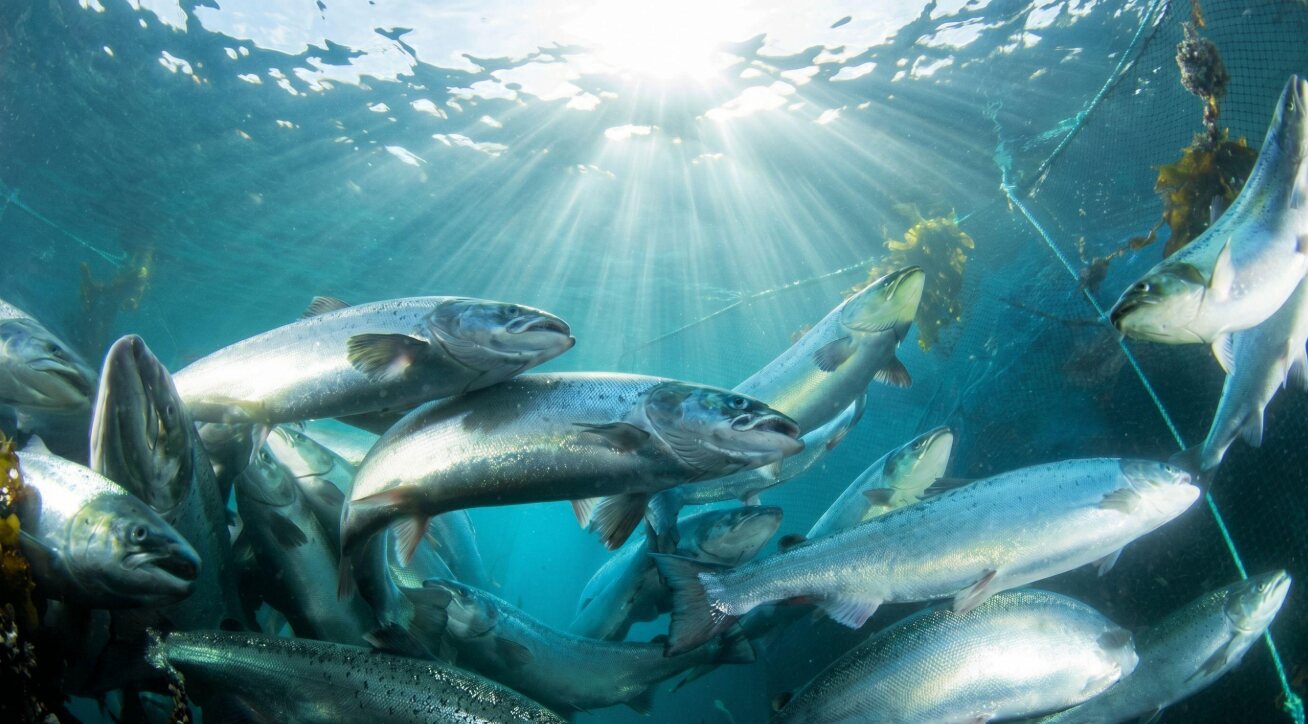
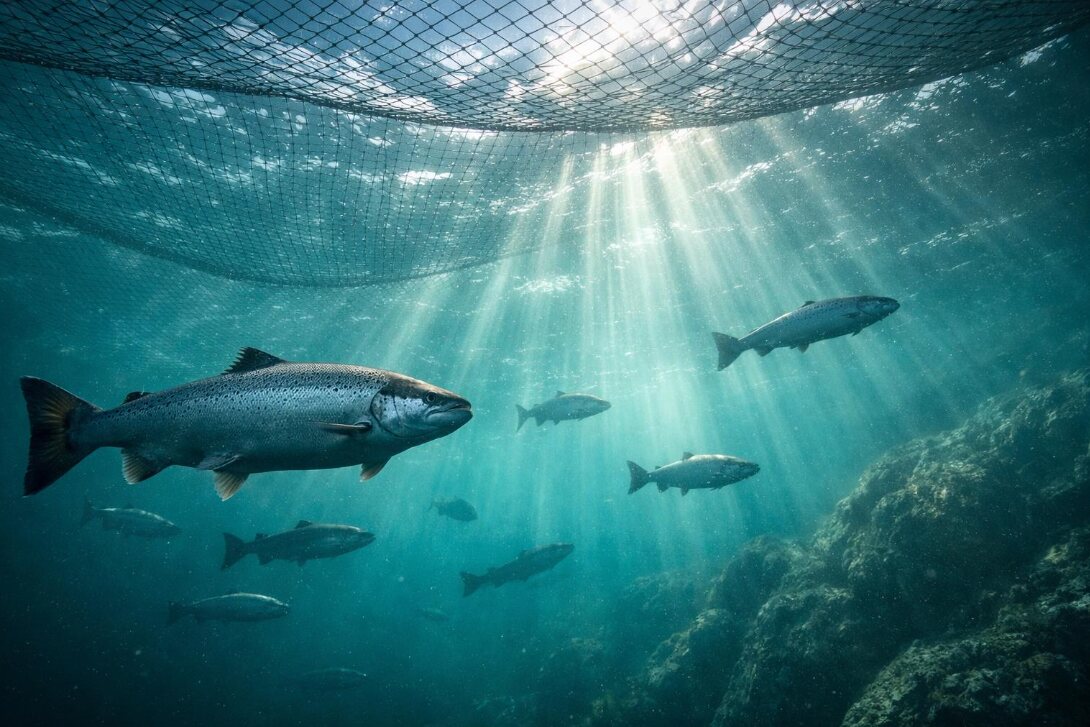
Project Slingshot describes farmed salmon as living in crowded, dirty underwater enclosures and presents intensive production as incompatible with fish welfare.
Salmon farming does involve very large numbers of fish. Whether that amounts to overcrowding depends on stocking density and welfare outcomes, not on headcount. Scottish farms operate under standards and monitoring covering fish health, water quality and husbandry; RSPCA Assured's Atlantic salmon standards, for example, set stocking limits and requirements across the life cycle.
A photograph of a pen holding thousands of fish cannot show whether density is excessive. That needs data on biomass, water volume, oxygen, behaviour and health. Equally, meeting a numerical limit does not guarantee good welfare, and the right density for salmon is a legitimate scientific debate.
What the evidence shows
Not demonstrated. Intensive farming is real, but the campaign does not show that Scottish farms are overcrowded simply because they operate at commercial scale.
Claim 02
Are sea lice eating farmed salmon alive?
Sea lice feed on the skin, mucus and blood of salmon, and severe infestations cause lesions, stress and secondary disease. On that point the campaign is right.
The question is how typical its images are. Sea lice occur naturally in the sea, although farming concentrates hosts and can change parasite dynamics. Scottish farms must report weekly average adult female lice counts, and the Scottish Government's Fish Health Inspectorate carried out 84 sea lice inspections and 12 enhanced inspections in 2025. Those figures describe inspection activity; they do not mean every site was inspected or every problem resolved.
Severe infestations have happened. What the campaign does not provide is prevalence data showing that its most disturbing footage represents normal conditions across the sector.
What the evidence shows
Partly accurate. Sea lice are a serious welfare problem, but extreme cases do not establish typical conditions on every farm.
Claim 03
Are salmon farms filling Scottish lochs with dangerous chemicals?
The campaign names formaldehyde, azamethiphos, emamectin benzoate and deltamethrin and links their use to harm to marine wildlife. Some of that concern is well founded: certain antiparasitic treatments can affect non-target species, especially crustaceans, which is why the Scottish Environment Protection Agency regulates discharges.
But the campaign groups together substances with different uses, exposure routes and rules. Formaldehyde is used against some fish-health problems; emamectin benzoate is an antiparasitic medicine; antibiotics treat bacterial infections. A substance can be hazardous while the actual risk depends on concentration, frequency, environmental fate and local conditions.
Project Slingshot cites more than 48,000 kg of formaldehyde used on Scottish farms in 2025, drawing on Animal Equality's analysis. That is a large quantity and warrants scrutiny. On its own, though, a total mass says nothing about concentrations in receiving waters, the number of sites involved or observed ecological effects. Nor is an authorised treatment automatically harmless; the test is whether use meets regulatory limits and monitoring shows surrounding ecosystems are protected.
What the evidence shows
Partly accurate. Chemical use and its environmental risks are real, but totals and hazard labels alone do not show what each discharge does.
Sources for this claim
- Animal Equality UK: Formaldehyde use and environmental breaches on Scottish salmon farms (18 March 2026), as cited by Project Slingshot
- Scottish Environment Protection Agency (SEPA): aquaculture discharge regulation
Claim 04
Have farm chemicals polluted 45 Scottish lochs?
This figure has a real basis. In 2017, the investigative outlet The Ferret reported that SEPA monitoring between 2006 and 2016 had found pesticide levels in sediments breaching environmental quality standards across 45 Scottish sea lochs and coastal areas. The industry needs to take that seriously.
It is, however, a finding about a monitoring period that ended a decade ago. The campaign does not say whether those sites still breach standards, which substances remain or what recent assessments show.
What the evidence shows
Accurate but incomplete. The historical breaches were documented; their current status needs up-to-date monitoring evidence.
Claim 05
Does a salmon farm produce as much waste as a town of 50,000 people?
Salmon farms release organic matter and nutrients from feed and fish metabolism, which can affect the seabed and water quality.
A comparison with a town needs its workings shown. Is it nitrogen, phosphorus, solids or organic matter? Based on one farm or average production? Is the town's sewage treated? Is it about emissions or their effects? A comparison can be arithmetically valid for one pollutant under narrow assumptions and still say little about overall impact. We could not trace the source of the figure the campaign uses.
Measurement choices cut both ways. A 2021 study in Nature comparing aquatic foods found that farmed salmon and trout used relatively little land and freshwater among fed aquatic species, while also showing trade-offs on nutrient emissions.
What the evidence shows
Not demonstrated. Nutrient and organic discharges deserve scrutiny, but the town comparison is meaningless without its pollutant, assumptions and boundaries.
Claim 06
Are farmed salmon artificially dyed pink?
The campaign argues that farmed salmon are fed a synthetic pigment to make their flesh look the way consumers expect.
The pigment, astaxanthin, is real and its use is no secret; producers also use colour guides to keep flesh colour consistent. But astaxanthin is a carotenoid found naturally in marine food webs. Wild salmon get it from their prey; farmed salmon get it from feed, where its source and dose are controlled. In both cases, dietary carotenoids colour the flesh.
Its safety has been assessed by European regulators. According to reporting on its April 2026 renewal assessment, the European Food Safety Authority found no new evidence requiring it to revisit its earlier safety conclusions for the additive under authorised conditions of use. Whether consumers prefer natural or synthetic sources is a fair question. Presenting the practice as painting fish to disguise a defective product is not.
What the evidence shows
Misleading. Feed-based pigmentation is real, but it is not the same as dyeing, and the additive has been assessed as safe under its authorised use.
Claim 07
Did 35 million Scottish salmon die before slaughter?
The figure comes from reported mortality data: Animal Equality counted roughly 35.9 million deaths on Scottish salmon farms between January 2023 and October 2025.
The number deserves attention, but without the population at risk, the production cycles and causes of death, it is not a mortality rate. The Scottish Government's 2025 production survey offers one: 68.8% of smolts put to sea in 2023 were eventually harvested, up from 61.8% for the 2022 cohort. Not all the remainder died; the government's method also counts fish removed through culling, sampling, escapes and broodstock selection. Salmon Scotland separately reports 82.3% survival across marine farms in 2024, using a different method that should not be compared directly with the government figure.
Comparisons with other livestock need the same care. Piglet pre-weaning losses cover weeks; broiler mortality covers a short growing cycle; salmon spend well over a year in production, much of it at sea. Showing that other farmed animals also die would not make salmon losses acceptable. The more useful measures for salmon are cohort survival, monthly trends, causes of death and differences between sites and years.
What the evidence shows
Accurate but incomplete. The deaths are documented, but the headline total lacks a denominator and a consistent time frame. Mortality remains one of the industry's most serious problems.
Sources for this claim
Claim 08
Did the industry use 1,564 kg of antibiotics in 2024?
Yes. The figure appears in Salmon Scotland's corrected reporting for 2024.
What the campaign leaves out is that the same reporting shows antibiotic use falling 67% from 2023, to 8.15 mg per kilogram of salmon produced, and that around 8% of farms needed antibiotic treatment in 2024 (7.1% of seawater sites and 10.6% of freshwater sites).
The government's own figures add a complication. The Veterinary Medicines Directorate publishes a separate estimate for salmon in its UK-VARSS report, but the 2024 edition was amended after publication and the two datasets differ in scope, including how freshwater and seawater stages are counted. Neither total should be treated as definitive until they are reconciled.
Antibiotic use is not in itself evidence of poor practice; treatment can be necessary for animal health. Overuse can drive antimicrobial resistance, which is why both the quantity and the trend matter. Antibiotics are also a separate question from antiparasitic treatments and from residues in the finished product.
What the evidence shows
Accurate but incomplete. The figure is real, but the campaign omits a large reported reduction and the differences between industry and government datasets.
Claim 09
Is salmon farming driving wild salmon towards collapse?
Interactions between farmed and wild fish are a legitimate scientific concern. Sea lice transfer, escapes and genetic effects have all been studied and require prevention and management.
The campaign's claim, though, is causal, and wild Atlantic salmon face many pressures: falling survival at sea, climate change, degraded rivers, barriers, predation and pollution. Aquaculture's risks belong in that wider picture rather than standing in for it.
The campaign cites sea lice infection pressure rising by up to 73 times. That figure comes from a 2005 study of juvenile pink and chum salmon migrating past a farm in British Columbia, Canada. It demonstrated an important mechanism for farm-to-wild transmission, but it did not measure Scottish Atlantic salmon, and different species, ecology and management limit how far it applies here.
Escapes are a genuine risk. In October 2025, around 75,000 salmon escaped from a Mowi farm in Loch Linnhe during Storm Amy. What that means for wild stocks depends on where escapees go, whether they survive and breed, and how they interact with wild fish.
What the evidence shows
Not demonstrated. Farms pose real risks to wild salmon, but the 73-fold figure comes from a Canadian study of other species, and the decline of Scottish wild salmon cannot be pinned on one cause without stronger evidence.
Sources for this claim
- Krkošek, Lewis & Volpe: Transmission dynamics of parasitic sea lice from farm to wild salmon, Proceedings of the Royal Society B (2005), summary and paper via Raincoast
- Scottish Government: fish farm escape records (2025)
Claim 10
Is Scottish salmon controlled by foreign corporations?
Largely, yes. Production is concentrated in a small number of large companies, several of them part of international groups.
But where a company is owned and where it creates economic activity are different questions. Farms employ local staff; boats need crews, nets need maintenance and sites depend on suppliers and contractors. The official production survey counted 1,410 people in seawater salmon production in 2025, a narrow figure that excludes processing, distribution and supply-chain jobs. The BiGGAR Economics study for Salmon Scotland estimates the wider sector supported 10,850 jobs and £953 million in gross value added in 2024. Jobs supported and value added are not the same as net benefit once alternative uses of capital, labour and coastline are counted, and the study was commissioned by the industry. That activity is still real, as are exports worth £828 million in 2025, according to HMRC data analysed by Salmon Scotland.
The campaign's focus on foreign ownership also sits awkwardly with its own funding. Project Slingshot is registered as a non-profit in the United States, and according to Fish Farming Expert its principal backers include the US-based Karuna Foundation and Coefficient Giving. That does not undermine its arguments. But if foreign funding does not delegitimise an advocacy group operating in Britain, foreign ownership alone should not erase a business's contribution in Scotland. What matters for both is what they do and how accountable they are.
What the evidence shows
Partly accurate. Ownership is concentrated and largely international, but the suggestion that the benefits therefore flow overseas ignores documented employment, supply-chain activity and exports.
Sources for this claim
- Scottish Government: Scottish Fish Farm Production Survey 2025, producers and employment
- BiGGAR Economics for Salmon Scotland: economic contribution 2024 (November 2025), via Fish Farming Expert
- HMRC export data analysed by Salmon Scotland: 2025 exports (February 2026), via Scottish Financial News
- Fish Farming Expert: The US money behind a vegan attack on Scottish salmon farming
Claim 11
Are taxpayers simply subsidising profitable multinationals?
Project Slingshot calls for an end to public money for industrial salmon farming and highlights grants to major producers.
Those grants exist. Scottish Government information releases document support under schemes including the European Maritime and Fisheries Fund and Marine Fund Scotland, and whether they are justified is a fair debate. But purpose matters. A 2026 review by the Sustainable Aquaculture Innovation Centre (SAIC) and Salmon Scotland identified 268 publicly supported innovation projects worth more than £183 million since 2018, over £83 million of them focused on fish health and welfare.
That does not prove every grant delivered value, or that profitable companies should automatically qualify. It does show that funding a technology to cut parasite-related welfare problems is a different proposition from subsidising operating profits. The right test is whether support delivers measurable public benefit: better welfare, environmental performance, innovation or regional jobs.
What the evidence shows
Partly accurate. Public grants are documented, but whether they are good policy depends on their conditions, outcomes and value for money, not on the size or ownership of the recipient.
The Scotland missing from the campaign
A salmon farm is easy to film as a row of pens in a sea loch. The communities around it are harder to show.
An AECOM study commissioned by Salmon Scotland found that on the Isle of Muck salmon farming directly employs around 34% of residents, and that on Westray, in Orkney, at least 20 pupils at the primary school have parents working on salmon farms. Residents interviewed for the study credited the industry with helping keep schools, businesses and year-round work going, and the study recorded contributions to broadband, transport and community facilities in places where population decline is a constant threat. It is industry-commissioned research, and its methods deserve scrutiny; the livelihoods it describes are real all the same.
Then there is the food. Scotland's 197,836 tonnes of salmon in 2025 represent a large supply of high-quality protein and long-chain omega-3 fatty acids, produced with a comparatively small land and freshwater footprint. That is not a case for ignoring the industry's impacts. It is a reason to judge food systems on more than one measure.
A higher standard for both sides
Project Slingshot has drawn attention to problems that deserve public examination: mortality, sea lice, chemical use and escapes among them. But a campaign built on distressing images, cumulative totals and chemical tonnages leaves out differences between farms, change over time, regulation, food production and what ending the industry would mean for remote communities. A campaign that wants salmon farming to end should be willing to weigh those consequences too.
The industry has its own obligations. Salmon Scotland and its members should publish comparable welfare indicators, explain treatment use clearly, report environmental performance and separate measurable progress from aspiration. The confusion over the 2024 antibiotics figures shows how quickly unclear reporting erodes trust.
Scottish salmon farming has serious problems, and it makes a substantial contribution to food, jobs and coastal life. Both are true, and an honest debate has to start there.
How we checked these claims
We started from Project Slingshot's own campaign materials (posters, film and published figures) and identified eleven specific, checkable claims. For each, we traced the number or statement to its origin and compared it with official records (Scottish Government statistics and inspection data, regulator reports, Veterinary Medicines Directorate data), peer-reviewed research and the industry's own reporting, separating what is documented from how it is interpreted. Each verdict says what the evidence shows, not whether the campaign's wider goal is right or wrong. Verdicts use four labels: Accurate but incomplete, Partly accurate, Misleading and Not demonstrated.
Where we stand
SALT. is a publication close to the seafood industry. We believe aquaculture and wild fisheries can and should coexist, and we do not support ending salmon farming in Scotland. Readers should weigh our verdicts with that in mind. This is an argued fact check: our conclusion is that the campaign gives an incomplete picture of Scottish salmon farming. Every verdict is based on the public record, and we set out the evidence behind each one, including the evidence that supports the campaign's concerns, so readers can test our conclusions for themselves.
Limits of the evidence
- Several economic and community figures come from studies commissioned by the industry body Salmon Scotland (BiGGAR Economics, AECOM) and have not been independently verified
- Official and industry datasets on antibiotics and survival use different scopes and methods and do not reconcile exactly, and the government's 2024 antibiotics report was amended after publication
- Some evidence is historical (pesticide monitoring 2006–2016) or comes from other countries and species (the 2005 British Columbia sea lice study)
- Figures on formaldehyde use and mortality come from an advocacy group's analysis of regulatory data
- We could not trace the source of the campaign's town-sized waste comparison
- We did not visit farms or carry out our own sampling
- Right of reply
- This fact check examines claims Project Slingshot and Salmon Scotland have made in public, against the public record. SALT. did not seek comment before publication. Both organisations are welcome to respond, and any response will be added here.
Spotted an error? Tell us. Corrections are published openly on this page.
Fresh Catch · The SALT. newsletter
Enjoyed this story? There's more where that came from.
Food, oceans, people and ideas. The most interesting stories from SALT., delivered to your inbox.
Free to read. Free to subscribe. Unsubscribe anytime. Privacy
About this story · 4 sources
Other sources cited
- Project Slingshot: Gaslit campaign and film (October 2026)
- AECOM for Salmon Scotland: community impact study, via Fish Farming Expert
- Scottish Government: Scottish Fish Farm Production Survey 2025
- Gephart et al.: Environmental performance of blue foods, Nature (2021)
Spotted an error? Tell us. We correct the record openly.