The ocean's biggest food revolution isn't happening at sea.
For the first time, farms produce more of the world's aquatic animals than fishing boats do. That isn't the end of the wild catch. It's the start of a seafood system that needs both.
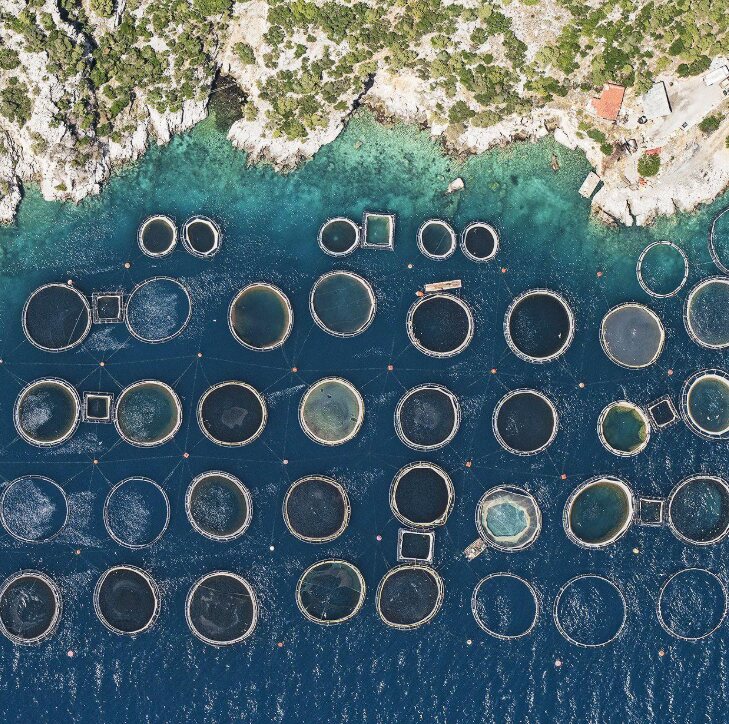
94.4 million tonnes. That is how much aquatic animal life the world's farms produced in 2022, according to the UN Food and Agriculture Organization's State of World Fisheries and Aquaculture 2024 report. It was 51% of the global total, and the first time in history that aquaculture outproduced capture fisheries.
The milestone arrived quietly. Most of us still picture seafood as boats, nets and open water, yet a growing share of what lands on the counter (salmon, prawns, mussels, sea bass, trout) started life in a hatchery, a pond, a coastal pen or a tank.
It is tempting to read the FAO figures as a story of farming pushing fishing aside. They say something different. Wild capture has held broadly steady for decades; the growth in seafood supply has come from farms. The two sectors split the world's aquatic animal production almost exactly in half, and both are needed to meet a demand that keeps rising.
They are also tied together in practical ways. Fishmeal and fish oil from wild fisheries, increasingly made from the trimmings of fish caught for food, are concentrated into feed for farmed species. Hatchery science developed for aquaculture supports restocking and research on wild populations. Processing plants, ports, cold chains and coastal workforces often serve both. A region with a healthy fishing fleet and a well-run farming sector has a more resilient seafood economy than one that relies on either alone.
A salmon farm in Norway, a shrimp pond in Ecuador, an oyster bed in France and a carp operation in China share a category and little else. Salmon and shrimp eat formulated diets that can combine marine ingredients, crops and newer sources such as microalgae. Mussels and oysters need no feed at all: they filter their food from the surrounding water. Lumping them together under one environmental verdict tells you very little about any of them.
The real problems are just as specific. Disease, animal welfare, water quality, habitat conversion (mangrove loss to shrimp ponds is the classic example) and feed sourcing all depend on species, site and how well a farm is regulated and run. Poorly managed production does real damage, and the sector's credibility rests on fixing it rather than talking around it.
The FAO's numbers also correct a Western-centric picture. Asia accounts for around 70% of the world's aquatic animal production overall, and roughly nine-tenths of all aquaculture output. Ten countries, led by China, produced almost 90% of the world's farmed aquatic food in 2022; Norway and Chile are the only ones outside Asia and Africa on that list.
So at the seafood counter, the useful questions are which species it is, how it was produced and where. A word on the label, farmed or wild, answers none of them on its own.
Fresh Catch · The SALT. newsletter
Enjoyed this story? There's more where that came from.
Food, oceans, people and ideas. The most interesting stories from SALT., delivered to your inbox.
Free to read. Free to subscribe. Unsubscribe anytime. Privacy
About this story · 3 sources
Sources
- FAO, The State of World Fisheries and Aquaculture 2024: aquaculture production
- FAO Regional Office for Asia and the Pacific, SOFIA 2024 release
- SeafoodSource, SOFIA 2024 summary
Spotted an error? Tell us. We correct the record openly.