The seafood story hidden in mangrove roots
Mangroves raise the young fish and crabs that coastal fisheries live on, and they shelter the ponds that farm shrimp. Shrimp farming once cleared them at scale. Now some of the restoration is being led from shrimp farms.
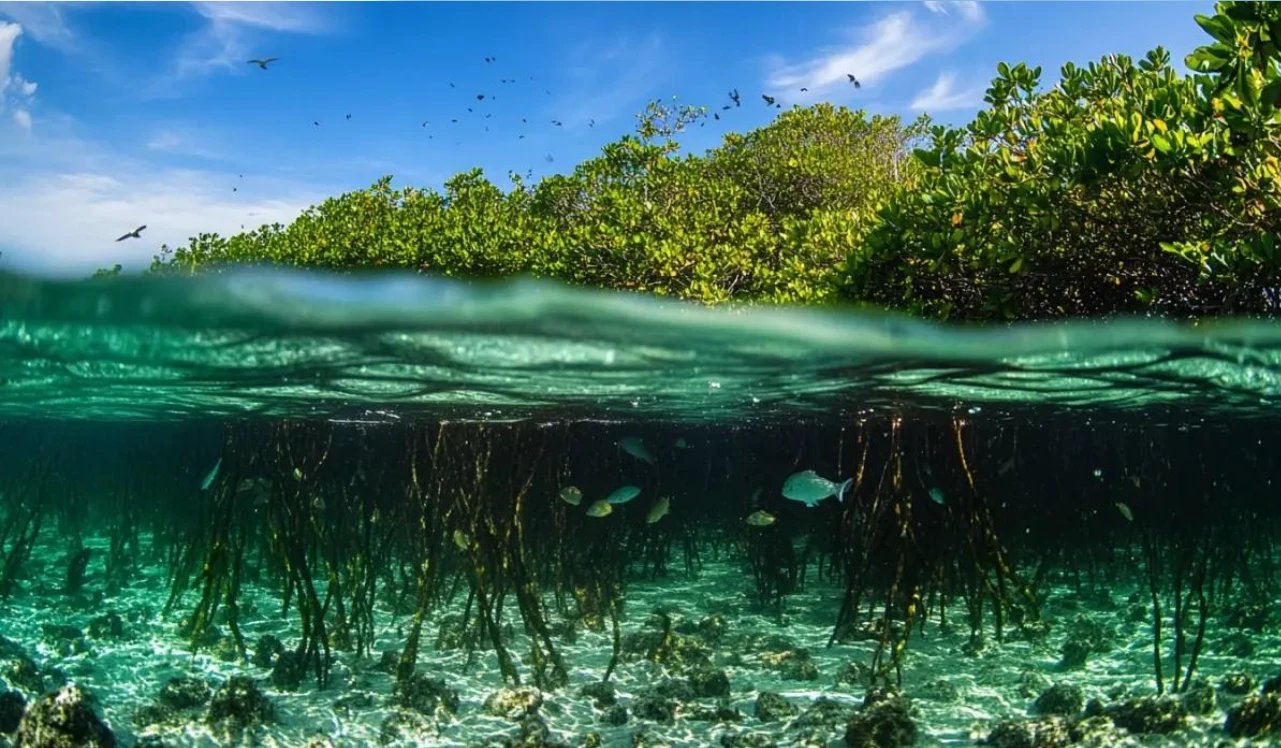
The world has about 147,000 square kilometres of mangrove forest, a little more than the area of England, according to the Global Mangrove Watch mapping used in the Global Mangrove Alliance's State of the World's Mangroves 2024 report. It grows in a thin, tangled band along tropical and subtropical coasts, where salt water meets mud. There is no auction clock or cold store in sight, yet a large share of the seafood caught along those coasts starts life among the roots.
Mangrove roots break up the current and keep big predators out, which makes them good places to be small. A study published in 2025 in Communications Earth & Environment put a number on it for the first time. Modelling 37 commercially important species of fish and invertebrates that make heavy use of mangroves, its authors estimated that the forests support more than 700 billion juveniles every year. They are careful to say this is a head count, not a catch forecast: most young animals never reach market size. It still gives a sense of how much of the coastal fishery is raised in this one habitat before moving out to estuaries and open water.
Some fisheries never leave the forest. On Ecuador's Pacific coast, artisanal fishers pull mangrove cockles by hand from the mud around the roots and catch red mangrove crab among them. Since around 1999 the state has handed stretches of forest to fishing associations under custody agreements, in which communities protect the mangrove in return for the right to harvest it. According to the Green Climate Fund, which backs the programme, 116,000 hectares were under community protection by July 2026. Mongabay's reporting from the Gulf of Guayaquil describes crab fishers keeping two closed seasons a year and leaving females and juveniles in the water. It is a fisheries-management success built on a forest.
The same trees protect what sits behind them. A 2020 study in Scientific Reports valued the flood protection mangroves provide at more than US$65 billion a year and estimated that, without them, around 15 million more people would be flooded annually. Those people include fishers, processors and the owners of the shrimp farms and landing sites on the same shoreline.
Aquaculture's part in this story has to be told straight. FAO's global assessment, The world's mangroves 2000–2020, found that 677,000 hectares were lost over those two decades, and pond shrimp farming was the leading aquaculture cause. The report also shows how fast that has changed. Shrimp farming's share of mangrove loss fell from 31% in 2000–2010 to 21% in 2010–2020, and the overall rate of loss dropped by 23% between the two decades. Natural expansion and restoration added back 393,000 hectares, leaving a net loss of 284,000. The second-biggest driver of loss, at 26%, was natural retreat of the coastline, partly linked to climate change.
The pressure has not gone away. The IUCN's first Red List assessment of mangrove ecosystems, published in 2024, classed half of the world's mangrove provinces as threatened. But the rules inside the shrimp industry now point the other way. The Aquaculture Stewardship Council's shrimp standard does not certify farms that converted mangroves after 1999, and farms built before then must rehabilitate at least half of the area they affected. ASC says it is reviewing the standard, with tighter mangrove requirements on the table.
The bigger shift is farmers treating the mangrove as part of the farm. In Ca Mau, at the southern tip of Vietnam, integrated mangrove-shrimp systems raise black tiger prawns in ponds threaded through standing forest. Under the Selva Shrimp programme the prawns get no added feed or fertiliser, and the Global Seafood Alliance reports that most participating farms keep at least half their land under mangrove cover. Indonesia has its own versions, known as silvofishery, with the forest planted in the middle of the pond or alongside it. A 2024 Stanford Blue Food Action Lab report says the approach can revive unproductive ponds and protect coastlines, while noting that it is hard to scale and demands training.
In Ecuador the shrimp producer Omarsa signed a restoration agreement with ASC and the French seafood company Labeyrie Fine Foods in May 2025. It covers 10 hectares near one of Omarsa's farms in the Gulf of Guayaquil, with residents of the local commune growing and planting the seedlings. Ten hectares is small. What matters is that a farm has made the forest next door part of its business.
Restoration also needs to be done properly. At Tiwoho, in Indonesia's Bunaken National Park, six attempts to replant abandoned shrimp ponds failed because the pond walls still kept the tide out. What worked was breaching the dykes in a few strategic places so seawater could flow in and out as it once did, which let the site recover. Old pond land is in many places the most promising ground for bringing mangroves back, and the people who know how to move water through it are pond farmers.
The Mangrove Breakthrough, a global initiative backed by governments and conservation groups, aims to mobilise US$4 billion to secure the future of 15 million hectares of mangroves. Fishers and shrimp farmers need it to succeed more than anyone. The cockle collector, the crab fisher and the farm manager depend on the same forest, and the evidence from Ecuador, Vietnam and Indonesia shows that it can be managed for all three.
Fresh Catch · The SALT. newsletter
Enjoyed this story? There's more where that came from.
Food, oceans, people and ideas. The most interesting stories from SALT., delivered to your inbox.
Free to read. Free to subscribe. Unsubscribe anytime. Privacy
About this story · 13 sources
Sources
- IUCN, New State of the World's Mangroves report underscores critical links between biodiversity, climate and people
- Global Landscapes Forum, The State of the World's Mangroves 2024
- FAO, The world's mangroves 2000–2020 (via ReliefWeb)
- FAO, Mangrove management: distribution
- Edinburgh Napier University, Mangroves support an estimated annual abundance of over 700 billion juvenile fish and invertebrates
- UC Santa Cruz, mangroves and global flood protection (Scientific Reports, 2020)
- Mongabay, How community custody empowered Ecuador's crab catchers and revived its mangroves
- Green Climate Fund, How Ecuador is scoring climate goals
- ASC, Shrimp standard in plain English
- ASC, Labeyrie Fine Foods and Omarsa join forces to restore Ecuador's mangrove forests
- Global Seafood Alliance, Selva Shrimp, produced in harmony with mangrove forests in Vietnam
- Stanford Blue Food Action Lab, student report on aquaculture (2024)
- Blue Forests, Ecological mangrove rehabilitation in Tiwoho village
Spotted an error? Tell us. We correct the record openly.