Why do fish swim together?
Thousands of fish turn as one, and nobody is giving the orders. The rules behind a school are simple. What they do for the fish, and for the people who catch them, is not.
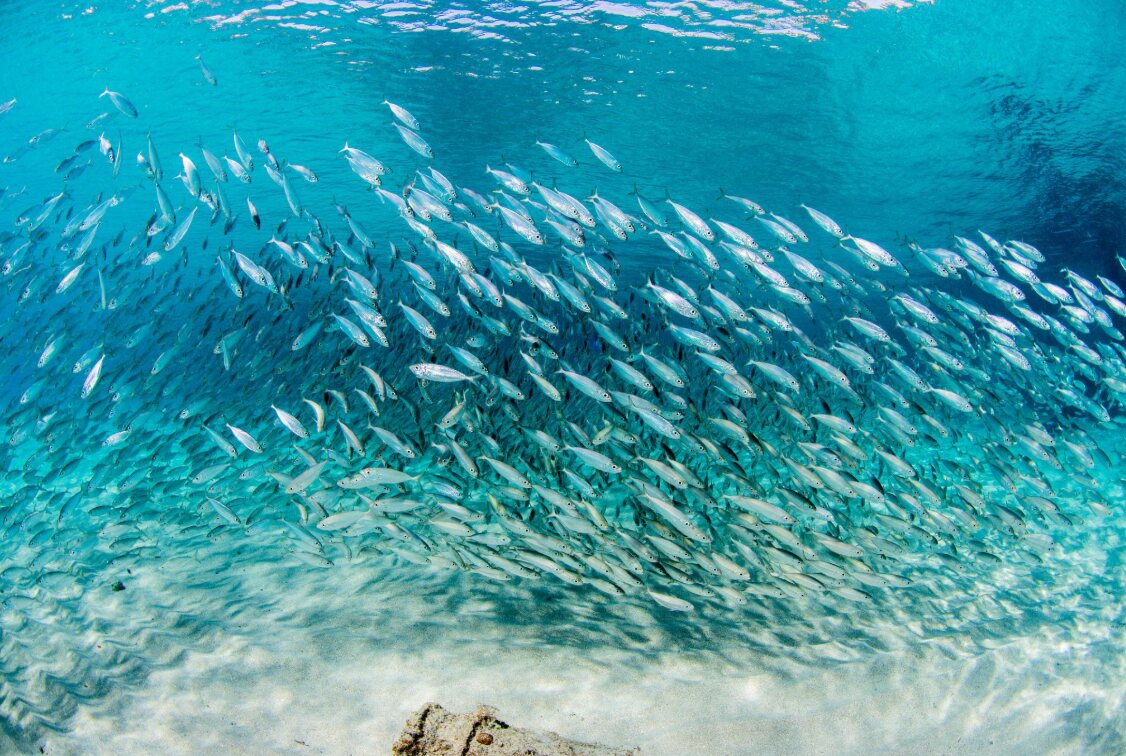
A shoal of sardines is drifting left. Something changes at one edge (a shadow, a pressure wave, a flash of a predator's flank) and within a moment the whole group has swung away, a ripple of silver crossing thousands of bodies. It looks rehearsed. It isn't.
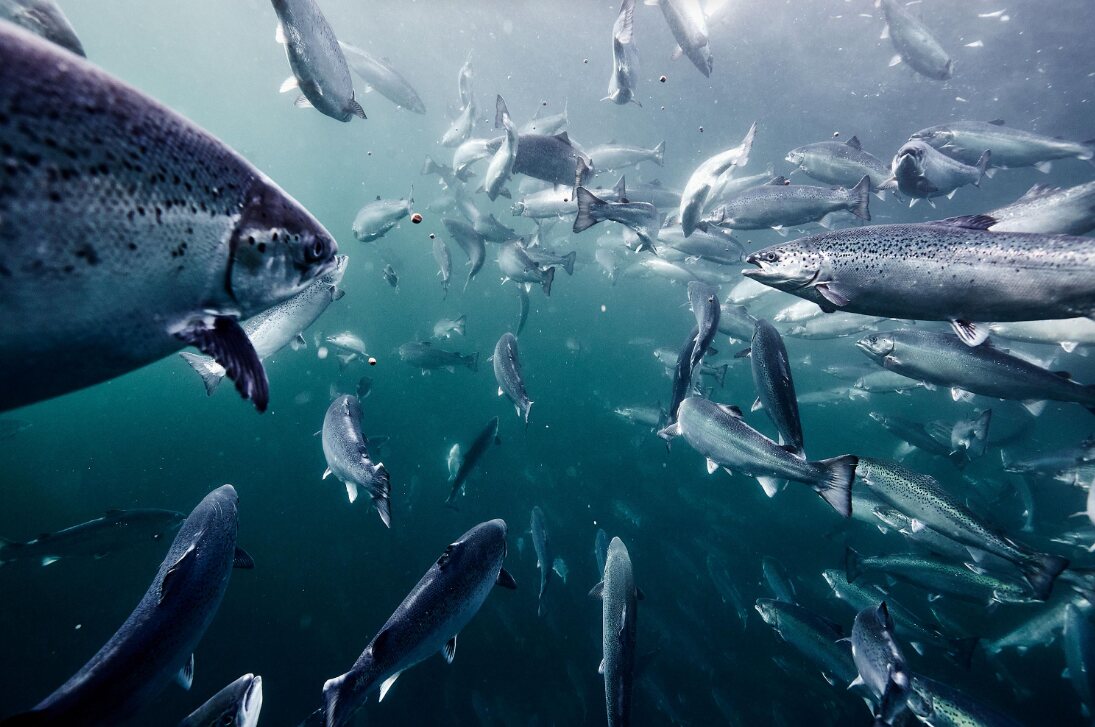
There is no leader in a fish school. The coordination comes from each fish following a few local rules about its nearest neighbours: don't get too close, stay close enough, and match their direction and speed. Computer models built on those rules alone produce something that looks very like a real school. Tracking studies of live fish point the same way: individuals respond mainly to a handful of fish around them, especially those just ahead, and a change of direction passes outward from fish to fish. When a few fish at the edge spot an attacker, their escape sets off a wave of fleeing that spreads rapidly across the whole school, carrying the warning to fish that never saw the threat.
Fish keep station using two senses. Vision is the main one: many schools loosen or break up in darkness. The second is the lateral line, a row of sensors along the body that picks up movement and pressure changes in the water. In classic experiments, fish that were temporarily blinded could still hold their place in a school, though they spaced themselves more widely. Only when both vision and the lateral line were blocked did schooling fail.
Biologists also separate two kinds of group. A shoal is any gathering of fish that stay together for social reasons. A school is a shoal moving in tight, aligned formation. The same fish can switch between the two, loosely milling while feeding, then closing up and turning in unison when threatened.
Safety is the main payoff, and it works in several ways at once. A predator that takes one fish from a crowd leaves each individual with better odds than if it swam alone. Hundreds of eyes spot danger sooner than one pair. And a mass of near-identical, fast-moving bodies makes it hard for a hunter to fix on a single target. The predators know it too. In one experiment, Australian salmon attacking swarms of tiny shrimp-like mysids succeeded more often when hunting in small groups than alone, which the researchers read as a way of getting round the confusion effect.
Schools can also save energy. Fish swimming behind and beside one another can use the swirls of water shed by their neighbours. Work with robotic fish suggested that a follower can cut its effort by timing its tail beat to the vortices left by the fish in front, and a study of live giant danios published in eLife measured energy savings of up to 56% per tail beat for fish swimming in a school compared with fish swimming alone. Groups may also find food faster, since one fish that finds a patch soon draws others to it.
The behaviour that protects sardines, anchovies, herring and mackerel from tuna and dolphins is also what makes them catchable at scale. Purse-seine fleets work by finding a dense school and encircling it, and the world's largest fisheries by volume are built on schooling species. That has a management consequence that fisheries scientists take seriously. Because fleets can keep finding dense schools even as the overall stock shrinks, catch rates can stay high while numbers fall, an effect known as hyperstability, often only recognised after a stock has been depleted. Sound management of schooling fish therefore leans on independent evidence, such as acoustic surveys from research vessels, not just on how full the nets are.
The same local rules turn up well beyond the sea, in starling flocks, locust swarms and the control systems engineers write for drone fleets and robot teams. It takes no plan for a sardine school to move as one, only thousands of fish paying close attention to the few closest to them.
Fresh Catch · The SALT. newsletter
Enjoyed this story? There's more where that came from.
Food, oceans, people and ideas. The most interesting stories from SALT., delivered to your inbox.
Free to read. Free to subscribe. Unsubscribe anytime. Privacy
About this story · 9 sources
Sources
- Pitcher (1983), via NOAA SWFSC: fish schooling definitions
- Reed College: Fish schooling: mechanisms
- Science News: School rules
- Cosmos: Secrets of schooling
- Zhang & Lauder, eLife: Energetics of collective movement in vertebrates
- Physics World: Fish save energy by swimming in schools
- Foster et al. (2001), University of Tasmania: schooling and predator confusion
- National Geographic: Swarm, shoal, flock, hive, brain
- WCPFC: Hyperstability in purse-seine CPUE (working paper)
Spotted an error? Tell us. We correct the record openly.