Why is salmon pink?
Salmon is so famously pink that we named a colour after it, yet the fish can't make the pigment itself. Wild or farmed, every pink fillet starts with something a salmon ate.
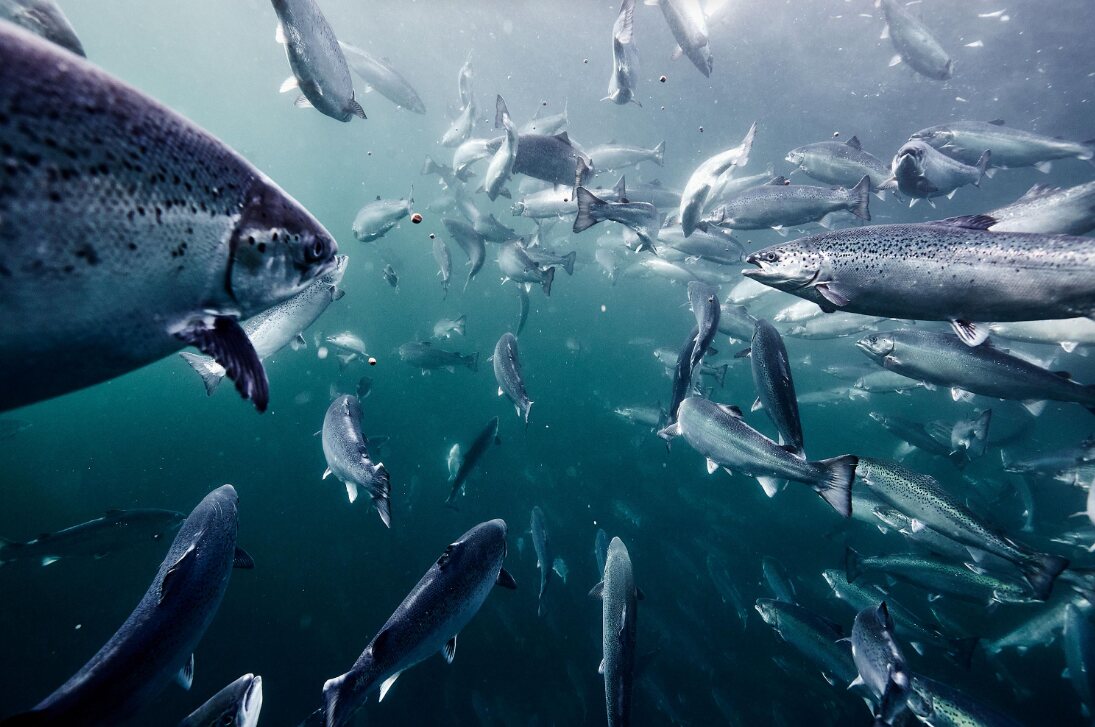
A salmon cannot make its own colour. The pink, orange or deep red of its flesh comes from astaxanthin, a carotenoid pigment made by microalgae and some other microorganisms. Tiny crustaceans such as krill and copepods eat the algae and store the pigment, and salmon eat the crustaceans. What the fish absorbs is laid down in its muscle. Without it, salmon flesh would be pale.
Diet explains most of the range at the fish counter. Sockeye, which feed heavily on krill and other zooplankton, are among the reddest salmon in the sea. Pink salmon, true to the name but not the stereotype, are much lighter. Chinook, or king salmon, eat more fish and so tend to be paler than sockeye, and a minority of wild chinook carry a genetic trait that stops them storing the pigment at all. These ivory or white kings are sold as a speciality, with flesh the colour of cream.
Farmed Atlantic salmon are fed astaxanthin in their feed, and the pigment takes the same route as in the wild: eaten, digested, absorbed and deposited in muscle. The flesh is not dyed, injected or soaked after harvest.
There are good reasons for adding it beyond appearance. Astaxanthin is a strong antioxidant and a precursor of vitamin A in fish, and EU feed-safety assessments describe it as important for growth and survival in salmonids. It is also inefficient: salmon normally retain less than a tenth of the astaxanthin they eat in their muscle, which is why it has to be supplied steadily through the growing cycle.
Most of the astaxanthin used in salmon feed has long been synthetic. It is the same pigment molecule, although the mix of its mirror-image forms differs from that found in wild fish. Natural sources are authorised and used too, including the red yeast Phaffia, the microalga Haematococcus and the bacterium Paracoccus, but they hold a small share of the feed market. Some producers also use a related carotenoid, canthaxanthin.
Pigments in feed are regulated. In the EU, astaxanthin is authorised as a feed additive for salmon and trout with a maximum of 100 mg per kilo of complete feed, and that ceiling applies to the total when it is mixed with other carotenoids. Canthaxanthin has its own, lower limit of 25 mg per kilo, set after European scientific advisers reviewed consumer safety. In the United States both pigments are approved colour additives for salmonid feed, and US regulators concluded in 2009 that people eating farmed salmon fed approved pigment sources take in amounts comparable to those from wild salmon. US labelling rules require farmed salmon fed these pigments to be identified as containing added colour, and large grocers including Kroger, Safeway and Albertsons show this on packs or at the fish counter.
Farmers check the result with a colour scale. The SalmoFan, a fan of 15 numbered strips from 20 (pale) to 34 (intense red), has been the industry reference for more than 25 years, and dsm-firmenich now sells a digital version that scores fillets by device instead of by eye. The scale exists because buyers specify colour, and because colour is hard to control. Research at the Norwegian institute Nofima has found that farmed fillets have grown paler even as pigment use in feed increased, and linked the problem to stress and fish health. Fish fed high levels of both vitamin A and astaxanthin held their colour better.
The colour itself tells shoppers less than they assume. A deeper shade says something about a salmon's diet, species and health, but not about freshness, fat content or how responsibly it was produced. A pale wild pink salmon and a deep-orange farmed Atlantic can both be excellent, and the colour of either comes from the same pigment moving through the same biology. The difference is that on a farm, people choose the menu and, by law, say so on the label.
Fresh Catch · The SALT. newsletter
Enjoyed this story? There's more where that came from.
Food, oceans, people and ideas. The most interesting stories from SALT., delivered to your inbox.
Free to read. Free to subscribe. Unsubscribe anytime. Privacy
About this story · 13 sources
Sources
- Wild Alaskan Company: Why salmon are pink, orange or red
- Chowhound: Why some salmon look red while others look pink
- Global Seafood Alliance: Can farmed salmon retain flesh color under stress?
- Aquaculture Europe 2021: astaxanthin and vitamin A in salmon
- EUR-Lex: Commission Implementing Regulation (EU) 2015/1415 (astaxanthin as a feed additive)
- EUR-Lex: Commission Directive 2003/7/EC (canthaxanthin)
- dsm-firmenich: Digital SalmoFan
- Federal Register (2009): color additive listing, astaxanthin and canthaxanthin intake from farmed salmonids
- Progressive Grocer: Safeway joins Kroger and Albertsons in farmed salmon labelling change
- Engormix: Pigmenting carotenoid sources for salmonid fish
- Knowmade: Can microbial astaxanthin disrupt the market?
- EUR-Lex via legislation.gov.uk: Regulation (EC) No 721/2008 (Paracoccus carotinifaciens)
- British Journal of Nutrition: Bioavailability of astaxanthin stereoisomers from wild and farmed salmon
Spotted an error? Tell us. We correct the record openly.