An octopus is a lot more than eight arms.
Three hearts, blue blood and a nervous system that lives mostly in its arms. The octopus is one of the strangest animals in the sea, and the question of whether it should be farmed has become one of seafood's most heated debates.
An octopus has three hearts. Two push blood through the gills; the third drives it around the rest of the body. The blood itself is blue, because it carries oxygen on haemocyanin, a copper-based protein, where ours uses iron-based haemoglobin.
Then there are the arms. An octopus has roughly 500 million neurons, in the same league as a dog, and about two-thirds of them sit outside the central brain, most of them in the arms. Each arm can explore, grip and react to what it touches without waiting for detailed orders from the centre. How independent the arms really are is still argued over: some research suggests they stay more closely connected to the brain than the popular idea of arms that think for themselves allows. Either way, it is a very different way of running a body from ours.
With no skeleton, an octopus can squeeze through any gap its hard beak will pass. Its skin works like a display screen. Chromatophores, small sacs of pigment ringed by muscle, stretch and contract to change colour in a fraction of a second, reflective cells underneath add sheen, and raised skin projections called papillae change its texture from smooth to spiky. An octopus sitting on a rock can match the rock in colour, pattern and surface.
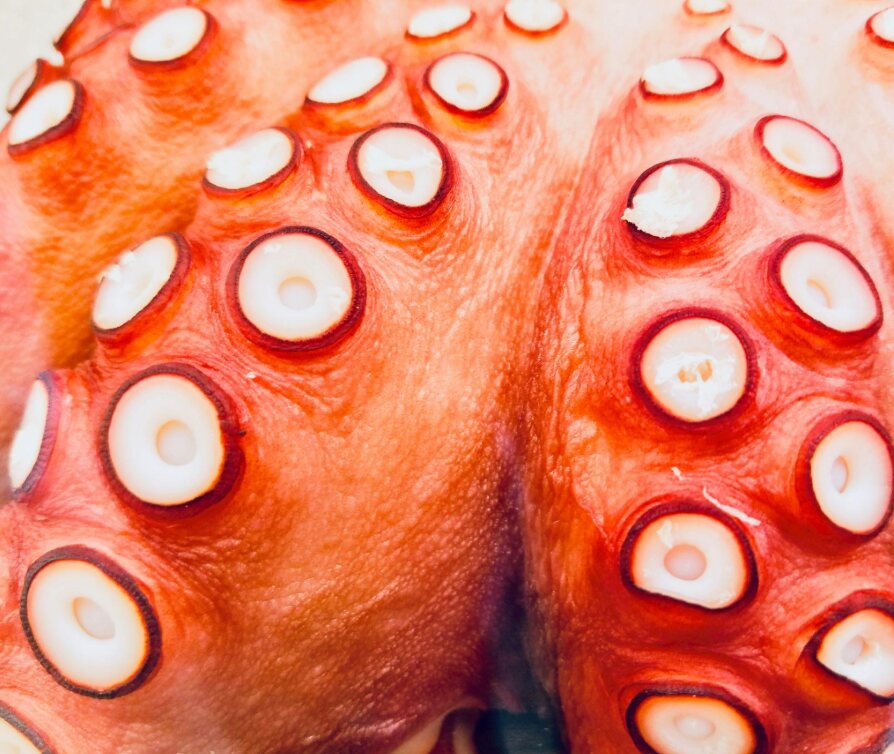
The suckers do more than hold on. A 2020 study published in Cell identified chemotactile receptors in the suckers that respond to molecules on the surfaces they touch, which lets an octopus taste what it is handling. An arm probing a crevice is feeling and smelling its way at once.
Octopuses also learn, remember and solve problems. In laboratories and aquariums they open containers, work through puzzles and handle objects with precision. Their intelligence evolved along a completely separate line from ours: the last ancestor we share was a simple, worm-like animal living more than half a billion years ago. That is part of why octopuses are hard to study, and why tests designed around mammals can underrate them.
That intelligence now sits at the centre of a commercial argument. Octopus is a valued food across the Mediterranean, East Asia and Latin America, and wild catches have struggled to keep pace with demand. Global landings have hovered around a few hundred thousand tonnes a year for more than a decade, stock assessment is difficult, and in Spain, one of the biggest markets, fishers and scientists report a long-term decline in local catches, with seasonal closures and growing reliance on imports.
Farming has long been the obvious industry answer, and it was technically hard. Octopus larvae are notoriously difficult to raise. In 2019 the Galician seafood group Nueva Pescanova announced that its researchers had closed the life cycle of the common octopus in captivity, raising captive-born animals to adulthood and breeding. The company went on to plan a commercial farm at the port of Las Palmas in Gran Canaria, designed to produce around 3,000 tonnes a year. Supporters argued that farmed octopus could ease pressure on wild stocks, steady supply and keep the processing and trade jobs that depend on the species.
Opponents made three main arguments. Welfare groups argue that a solitary, intelligent and sometimes cannibalistic animal is poorly suited to high-density tanks, and objected to the slaughter methods they said were planned. Environmental critics point out that octopuses are carnivores whose feed would draw on fishmeal and fish oil. And scientists who reviewed the evidence for the UK government concluded in 2021 that there is strong evidence that cephalopods are sentient. As a result, octopuses, squid and cuttlefish were brought within the UK's Animal Welfare (Sentience) Act 2022.
Lawmakers have also moved. Washington became the first US state to ban octopus farming in March 2024, and California followed in September 2024 with a law that also bans the sale of farmed octopus. Similar bills have been introduced in Hawaii and in the US Congress.
In July 2026 Nueva Pescanova withdrew its application for the Las Palmas site. The company said new environmental assessment requirements had changed the scope, timing and conditions of the project, and left open the possibility of other sites or designs. Spanish press reports said the environmental review had raised concerns about odours near a passenger terminal and organic waste in the port's water. Campaign groups called it a victory.
The underlying problem has not gone away. Demand for octopus is still rising, and wild fisheries still need better stock assessment and management. If farming does return, it will have to answer the welfare and feed questions with evidence: slaughter methods, stocking densities and feed sources set out in public, not just a market case. The animal's biology is the reason this debate is harder than it was for salmon or sea bream. Any farm that wants public acceptance will have to be built around that biology.
Fresh Catch · The SALT. newsletter
Enjoyed this story? There's more where that came from.
Food, oceans, people and ideas. The most interesting stories from SALT., delivered to your inbox.
Free to read. Free to subscribe. Unsubscribe anytime. Privacy
About this story · 12 sources
Sources
- Smithsonian Ocean: How octopuses and squids change color
- BBC Science Focus: Why does an octopus have more than one heart?
- OIST: Do octopuses' arms have a mind of their own?
- Harvard Gazette: Octopus suction cups hold its taste and touch sensors (2020)
- LSE: Why octopuses, lobsters and crabs require legislative protection
- Nueva Pescanova: Closing the octopus reproduction cycle in aquaculture (2019)
- The Fish Site: Nueva Pescanova withdraws Las Palmas octopus farm plan
- The Olive Press: Octopus farm axed in Gran Canaria (July 2026)
- SeafoodSource: California becomes second US state to ban octopus farming
- CalMatters: California octopus farming ban
- AP via Food Manufacturing: As octopuses dwindle in Spanish waters, suppliers look to imports and farming (2025)
- SeafoodSource: Study outlines challenges to sustainable octopus management
Spotted an error? Tell us. We correct the record openly.