Aquaculture's credibility test: when the industry's story is no longer its own
Thousands of Tube adverts against Scottish salmon and a five-year investigation into the global fishmeal trade have put aquaculture's own account of itself on trial. Some of the criticism oversimplifies. Some of it is right. The industry's credibility depends on telling the difference in public, and on fixing what is broken.
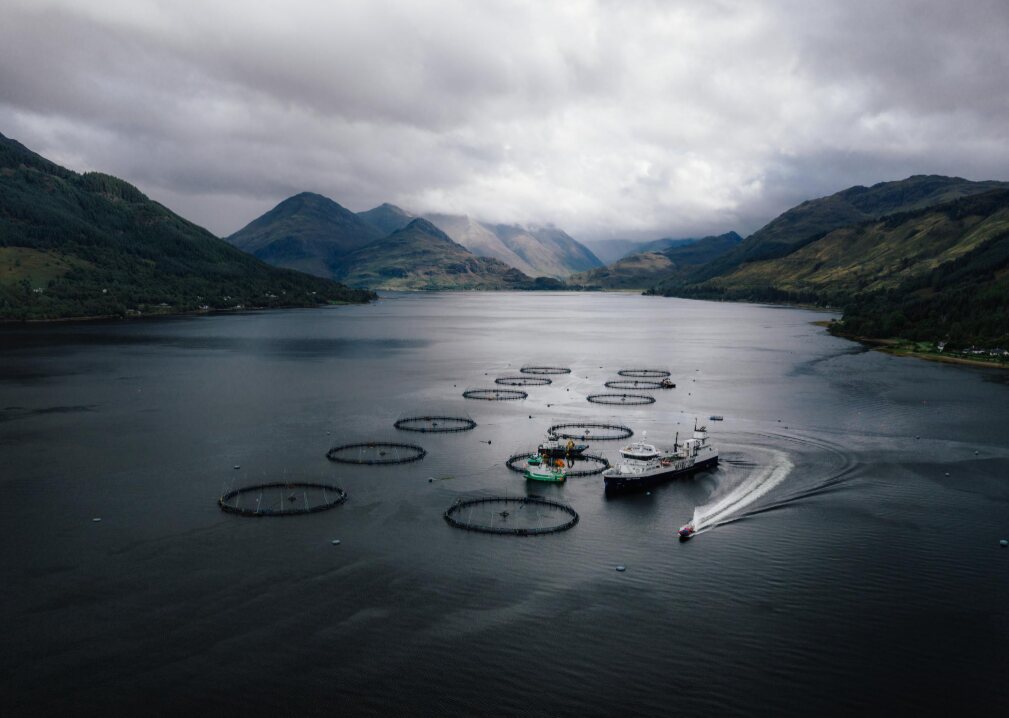
London commuters have been looking at a different picture of Scottish salmon. In place of misty lochs and glossy fillets, Project Slingshot's eight-week campaign shows sea lice, disease and chemical treatments, and asks Marks & Spencer to stop selling farmed salmon. The Grocer reported that it runs to more than 5,000 adverts on the London Underground, alongside a satirical film fronted by the broadcaster Chris Packham and an email campaign aimed at the retailer.
At the other end of the supply chain, the Outlaw Ocean Project, a non-profit investigative newsroom, has published Food for Feed, a five-year investigation into the fishmeal and fish oil trade that supplies fish farms. According to SeafoodSource, the reporting covers more than 1,000 fishmeal factories in 64 countries and comes with Bait to Plate, an online tool that maps links between vessels, plants, feed companies and seafood brands.
These are not the same kind of challenge, and the industry would be making a mistake to answer them in the same way. Both, though, go after the same thing: the story aquaculture tells about itself. SALT. is a publication close to the seafood industry, and we think that story is worth defending, which is why it has to be one the industry can prove.
Project Slingshot is open about what it is. It campaigns against factory farming, and its salmon work uses advertising, celebrity and satire to put pressure on retailers, not to negotiate improvements with producers. It describes itself as a registered charity funded by philanthropic foundations and public donations. Fish Farming Expert has reported that much of that money comes from US philanthropic sources, and Salmon Scotland has accused the group of a lack of transparency over its funders. Who pays for a campaign is fair to ask. It does not tell you whether the claims on the posters are true.
Some of those claims rest on real problems. Sea lice remain a serious health and welfare challenge, and mortality has been the sector's weakest point in public. In February, The Guardian reported more than 35 million unexpected salmon deaths on Scottish farms between January 2023 and October 2025, based on figures obtained under freedom of information by Animal Equality UK. The same reporting said the Animal and Plant Health Agency, which enforces welfare law, had inspected 21 of 213 active farm sites in that period. The Scottish Government says its Fish Health Inspectorate carries out around 250 statutory site inspections a year for disease surveillance, and Salmon Scotland maintains that Scottish farms meet some of the highest welfare and environmental standards in the world.
Both things can be true: a large disease-surveillance programme, and a thin record of welfare inspections at the sites with the highest losses. A 35 million total does not mean every farm had the same problem or the same cause. It does mean the industry cannot treat mortality as a technical footnote. Publishing site-level figures promptly, with causes and the steps taken, would take more heat out of this debate than any counter-campaign.
Where campaigns overreach, the industry should say so with evidence. The recurring claim that farmed salmon are dyed is a good example. Farmed fish get astaxanthin in their feed; wild salmon get the same carotenoid from the crustaceans they eat, and it is what makes both pink. Calling that dye misleads consumers, and it is the kind of point the industry can correct calmly and win. M&S, for its part, says it has worked with its supplier Scottish Sea Farms on low stocking densities and sources salmon to RSPCA Assured standards. Defending good practice is legitimate. Treating every critic as an enemy is not a strategy.
Food for Feed poses a harder test, because its subject is not one farm or one country but the system that supplies marine ingredients to aquaculture and to pig and poultry feed. Raw material passes through vessels, plants, traders and feed mills before it reaches a salmon pen or a shrimp pond, and each step is a place where accountability can thin out.
One case concerns the Cuncolim Industrial Estate in Goa, India. Government investigators raided fishmeal plants there in November 2020, and local reports say they found hidden boreholes used to dispose of wastewater; the Goa State Pollution Control Board sealed 10 illegal borewells at two units. The Outlaw Ocean Project reported on one of those plants, United Marine Products, which disputes the allegations. The investigation also documents community complaints elsewhere over emissions, water pollution and access to fish, and counts around 80 incidents of civil unrest, mostly strikes and protests, many of them in India, Peru and Senegal.
Certification is in the frame too. In its questions to companies, the Outlaw Ocean Project named individual plants that held MarinTrust certificates while, it alleges, processing species that were overfished or sourcing from fleets with recorded problems. Among them are the TripleNine plant in Norway, several Ecuadorian plants and plants run by Pesquera Diamante in Peru. These are allegations put to the companies, not findings of wrongdoing, and the responses are published alongside them; MarinTrust sent written answers in December 2025 explaining how its standards and improver programme work.
The distinction matters for what certificates can and cannot promise. A factory standard, a chain-of-custody scheme and a fishery improvement project each answer different questions. None is a guarantee that every vessel, worker and neighbour in a supply chain has been treated well, and the industry has sometimes let customers believe otherwise.
Aquaculture has real progress to show. Feed conversion has improved, fishmeal inclusion has fallen and more marine ingredients now come from processing trimmings that would otherwise be wasted. Farming and wild fisheries depend on each other: well-managed reduction fisheries supply the feed, and farmed fish take pressure off wild stocks for the table. That partnership is SALT.'s case for the industry. It only holds if the wild side is genuinely well managed and the people working in it are treated fairly.
Lower inclusion rates do not settle a labour-rights allegation, and a well-run farm does not disprove a mortality spike at another site. Bait to Plate also changes who can ask questions. Its links rest partly on historical trade data and do not prove that a given product contains a given batch, but a retailer can now be asked about a supplier several steps removed, by anyone with a browser.
The answer is not a better brochure. It is knowing where marine ingredients come from beyond the first supplier, publishing mortality and welfare data without being forced to, making claims no broader than the assurance behind them, and acting visibly when a supplier is found wanting. Correct the campaigns where they mislead; fix the problems where they are real. An industry that does both will not need to win every argument about its image, because the evidence will be doing the work.
Fresh Catch · The SALT. newsletter
Enjoyed this story? There's more where that came from.
Food, oceans, people and ideas. The most interesting stories from SALT., delivered to your inbox.
Free to read. Free to subscribe. Unsubscribe anytime. Privacy
About this story · 14 sources
Sources
- The Grocer, M&S urged to stop sourcing farmed salmon by Project Slingshot
- Fish Farming Expert, The US money behind a vegan attack on Scottish salmon farming
- The Scotsman, Chris Packham campaign takes aim at M&S over Scottish farmed salmon
- The Scotsman, Salmon Scotland accuses campaign group of lack of transparency over funding
- Salmon Business, New figures prompt scrutiny of salmon farm inspection regime
- Animal Equality UK, Scottish salmon farm deaths and inspections (6 February 2026)
- The Fish Site, Salmon dye claims has researcher seeing red
- Marks & Spencer, What makes M&S salmon responsibly sourced?
- SeafoodSource, Outlaw Ocean Project releases sweeping new reporting on problems in global fishmeal production
- The Outlaw Ocean Project, Food for Feed correspondence: MarinTrust
- The Outlaw Ocean Project, Food for Feed correspondence: United Marine Products
- The Outlaw Ocean Project, Food for Feed correspondence: Pesquera Diamante
- Herald Goa, Locate illegal borewells in Cuncolim units: GSPCB to cops
- The Goan, GSPCB revokes suspension orders for 4 fish units at Cuncolim IDC
Spotted an error? Tell us. We correct the record openly.