Can we feed fish without catching more fish?
Microalgae oils, insect proteins and processing leftovers are changing what goes into fish feed. The aim isn't to stop fishing for feed. It's to make every tonne of marine ingredient count for more.
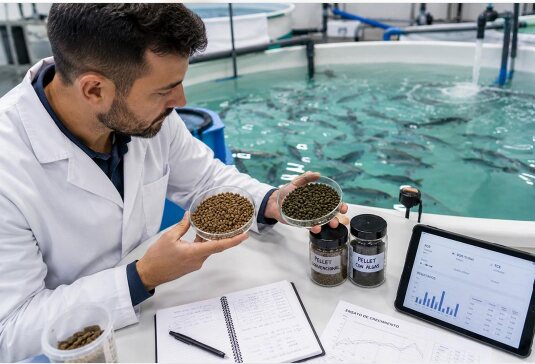
Open a bag of modern salmon or sea bass feed and you would find a recipe a fish farmer of the 1980s would barely recognise. Plant proteins, oils grown by microalgae, meal made from processing leftovers, and, in trial diets at least, insect larvae now sit alongside the marine ingredients that once made up most of the pellet.
The driver is simple arithmetic. Aquaculture keeps growing, while the wild fisheries that supply fishmeal and fish oil cannot grow with it. Feed makers have responded by using marine ingredients more strategically: as a concentrated source of the protein and long-chain omega-3s that fish need, blended with other ingredients rather than forming the bulk of the diet.
Fish don't make most of their omega-3s; they accumulate them from the algae at the bottom of the marine food chain. Growing those algae directly in fermenters or ponds is one of the most promising routes to omega-3 supply that doesn't depend on the size of a given year's catch. Species such as Nannochloropsis have been tested in European sea bass diets for years. Earlier work found that defatted Nannochloropsis biomass left over from biofuel production could replace part of the fishmeal in sea bass feed without harming growth.
The main obstacle is cost. Algal oils remain more expensive than fish oil, and production capacity is still small compared with the volumes salmon farming alone consumes.
Black soldier fly larvae can turn low-value organic material into a protein-rich meal, and several companies now supply it to feed makers. Its environmental case depends on details: what the larvae are fed, how much energy rearing and drying takes, and whether production can reach industrial scale at a competitive price. An ingredient being new doesn't make it sustainable.
The least glamorous innovation may matter most. Heads, frames and trimmings from fish processed for human food, wild-caught and farmed, can be turned into fishmeal and fish oil without catching a single extra fish.
A 2024 study in the journal Aquaculture put this to the test with juvenile European sea bass. Over an 88-day trial in a recirculating system, researchers fed diets built on fishery and aquaculture by-products, with Nannochloropsis microalgae, stepping down wild-caught fishmeal, fish oil and soy protein all the way to zero. Fully replacing wild-caught fishmeal with by-product meal did not affect overall growth, and the authors concluded that total replacement of wild-caught fishmeal and fish oil was possible with only a marginal drop in overall performance. Reporting on the study also noted that fillet omega-3 levels stayed in line with human nutrition guidelines.
That is one species, under experimental conditions. Cost, consistent supply and regulation decide whether a recipe makes it from the trial tank to the feed mill, and nutritional needs vary widely between species.
None of this makes reduction fisheries the villain of the story. Well-managed fisheries for small pelagic species, many of which have little direct food market, remain a legitimate and efficient source of marine nutrients, and by-product meal depends on a healthy fishing and processing industry in the first place. The realistic future of fish feed is a portfolio: responsibly sourced wild fish and trimmings used where they add most value, topped up by algae, insects and crops. The goal is more farmed seafood per tonne of wild fish, not a feed bag with no ocean in it.
Fresh Catch · The SALT. newsletter
Enjoyed this story? There's more where that came from.
Food, oceans, people and ideas. The most interesting stories from SALT., delivered to your inbox.
Free to read. Free to subscribe. Unsubscribe anytime. Privacy
About this story · 4 sources
Sources
- Marchi et al., Aquaculture 590 (2024) 741015
- We Are Aquaculture, report on the sea bass by-product study
- Valente et al., defatted Nannochloropsis in European sea bass diets
- Johns Hopkins Center for a Livable Future, by-products and aquaculture feeds
Spotted an error? Tell us. We correct the record openly.