El Niño is already reshaping the seafood industry. How far could the disruption go?
Peru has written off most of its first anchoveta season, fishmeal output is heading for a ten-year low and US forecasters now give better-than-even odds of a record-breaking El Niño. The shock has already reached the feed mill. Shrimp ponds and Pacific fisheries could be next.
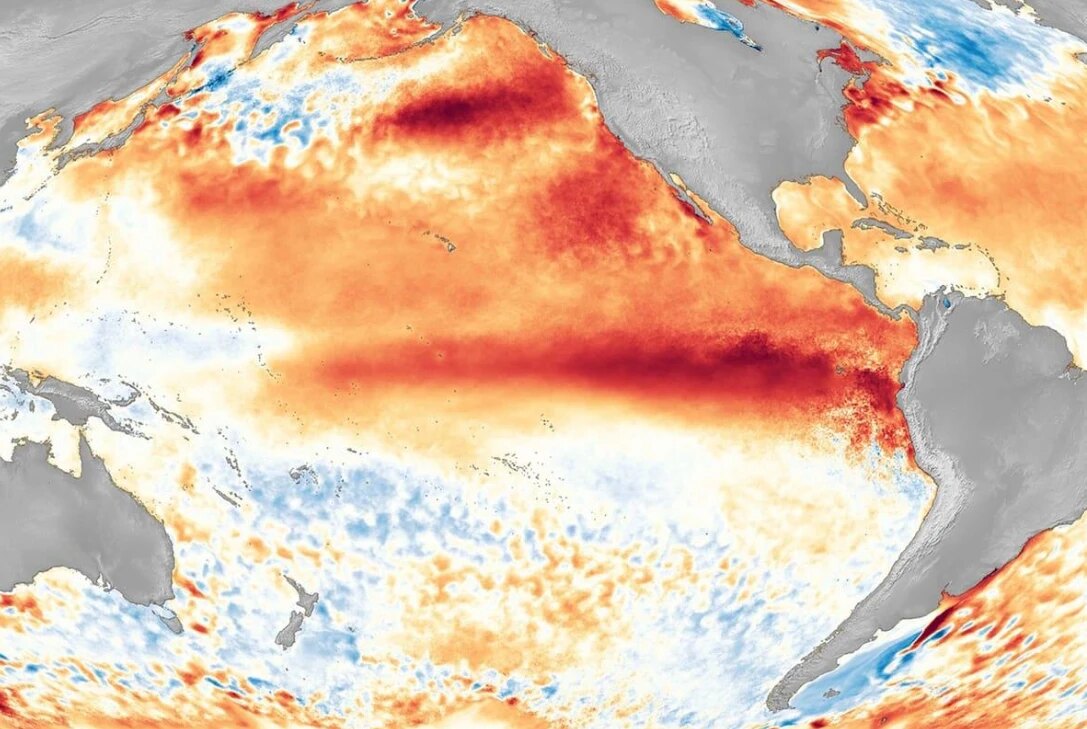
Sea surface temperature anomalies across the Pacific. Red marks water warmer than the long-term average, blue cooler. The warm band along the equator off South America is the signature of El Niño, and it sits right over Peru’s anchoveta grounds.
In April, Peru's anchoveta fleet sailed for the first season of 2026 with a quota of 1,914,049 tonnes, already the smallest in a decade. It never got close. Fishing was halted from 24 April to 3 May, stopped again in early June for what was meant to be 15 days and then kept closed indefinitely. When the Ministry of Production finally called time in August, after a scientific survey by the marine institute IMARPE, the fleet had landed about 471,000 tonnes, roughly a quarter of the quota, and 51.6% of that catch was juvenile fish. More than a million tonnes of anchoveta stayed in the water.
The season was cancelled, not paused. IMARPE found the population growing but still dominated by juveniles in persistently warm water, and the ministry judged that protecting the next generation of spawners mattered more than finishing the quota. For the world's largest fishmeal producer that is an expensive decision. It is also the right one: a closure is what a management system looks like when it works, and the cost of fishing through a vulnerable year would land on every season that follows.
The ocean behind those closures is still heating up. In its 8 October diagnostic discussion, the US Climate Prediction Center raised the chance that October to December would produce a historic event, stronger than any El Niño on record since 1950, to 83%, up from 75% a month earlier. Sea surface temperatures had risen across most of the monitored regions, reaching +3.0°C above average in Niño-3 and +3.9°C off the coast of Peru and Ecuador.
The mechanism is well understood. The Humboldt Current normally pushes cold, nutrient-rich water to the surface off Peru, feeding plankton and, in turn, vast shoals of small pelagic fish. When the trade winds slacken and warm water spreads east across the Pacific, that upwelling weakens. Anchoveta move deeper or bunch up closer to shore, where they are harder to fish and juveniles are easier to catch by mistake. Managers face less predictable access to the fish and less certainty about how much can safely be taken.
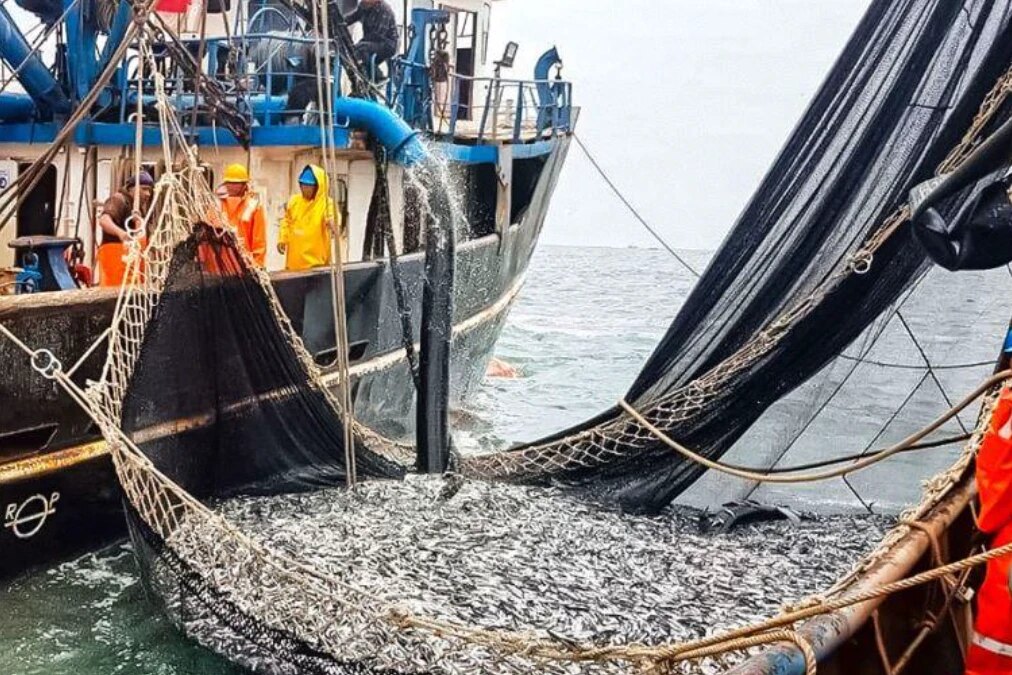
Peru normally supplies about a fifth of the world's marine ingredients, so a lost season shows up quickly in the global numbers. According to IFFO figures reported by the trade press, fishmeal production across the countries it monitors was 45% lower year on year through August, and fish oil output was down 26%. Those figures cover IFFO's monitored group, not every plant on earth, but the direction is unmistakable. IFFO now expects global fishmeal production in 2026 to fall below 4.6 million tonnes, the lowest since 2016, when output was 4.53 million tonnes, with fish oil sliding to around 1.15 million tonnes.
China, the biggest buyer, has little cushion. IFFO has reported that tight supply has held back Chinese fishmeal imports and pushed domestic inventories lower, leaving the country leaning on its own fleet and on processing by-products while aquafeed demand keeps growing.
For feed makers, the problem is less about bulk than about what marine ingredients do. Inclusion rates have fallen for years and formulators have plenty of alternatives for protein. Long-chain omega-3s are harder: vegetable oils do not supply EPA and DHA in the proportions fish oil does, and algal oils, while proven, are still limited in volume and price. Companies with diversified sourcing, flexible formulations and volumes locked in before the closures will ride this out better than those buying hand to mouth. Farmers of high-value species can absorb dearer feed more easily than those on thin margins.
None of this is an argument against aquaculture's link to wild fisheries. It is a reminder of why that link has to be managed well. A healthy anchoveta stock is the feed industry's best long-term asset, and Peru's willingness to leave fish in the sea this year protects the supply aquaculture will need in the next.
Feed is only one channel. In Ecuador, the world's leading shrimp exporter, the government's ENOS 2026 report counts 3,431 shrimp farms, of which 2,977 (86.8%) sit in areas with some degree of flood susceptibility, concentrated in Guayas, El Oro, Manabí and Esmeraldas. The aquaculture authority is offering technical assistance and risk assessments to farms, and the agriculture ministry has published a national El Niño contingency plan with 62 actions and a reference budget of $19.7 million. Ecuador's El Niño study committee, CN-ERFEN, expects the event to peak in November and December.
Heavy rain can drop pond salinity, overwhelm drainage and damage dykes and roads; warmer water holds less oxygen. How badly any farm is hit will depend on its location and management, but the timing, with the peak arriving months from now, means the shrimp sector still has time to prepare.
Further north, NOAA Fisheries has warned that El Niño on top of a large marine heatwave could disrupt species distributions and food availability along the US West Coast, with salmon among the species at risk. Some fleets will lose familiar fish; others will find species turning up in new places, with knock-on effects for processing, quotas and markets.
Three things will decide how far this goes: whether IMARPE's surveys support a second Peruvian season, whether marine ingredient inventories rebuild or drain further into 2027, and whether the floods and heat that forecasters expect turn into losses at farm level.
The lesson is that a highly engineered industry still runs on ocean physics. A temperature anomaly in the Pacific has already become a closure in Peru, a price problem for feed mills in Europe and Asia and a flood plan for shrimp farmers in Ecuador. The companies that treat wild fisheries as a resource to steward, not a commodity to bid for, are the ones best placed to come through it.
Fresh Catch · The SALT. newsletter
Enjoyed this story? There's more where that came from.
Food, oceans, people and ideas. The most interesting stories from SALT., delivered to your inbox.
Free to read. Free to subscribe. Unsubscribe anytime. Privacy
About this story · 12 sources
Sources
- NOAA Climate Prediction Center, ENSO diagnostic discussion, 8 October 2026
- SeafoodSource, Peru launches first North-Central anchovy season of 2026 with decreased TAC of 1.9 million tons
- Infobae, First North-Centre anchoveta season of 2026 opens at 1.9 million tonnes, lowest in a decade (in Spanish)
- SeafoodSource, Peru ends North-Central anchovy season after lengthy pause
- We Are Aquaculture, Peru ends first 2026 anchovy fishing season
- SeafoodSource, Latest IFFO report shows August uptick in fishmeal, but near-decade lows for year overall
- The Fish Site, IFFO forecasts lowest fishmeal and fish oil supply since 2016
- AgNavigator, China leans on domestic marine ingredients as El Niño squeezes fishmeal imports
- El Comercio, El Niño puts Ecuador's shrimp on alert (in Spanish)
- Primicias, Ecuador shrimp farms and El Niño flood risk (in Spanish)
- El Diario, El Niño: government invests $19.7 million to protect the agricultural sector (in Spanish)
- NOAA Fisheries, 7 ways El Niño and large marine heatwave could affect West Coast marine species
Spotted an error? Tell us. We correct the record openly.