Who decides how much tuna the world can catch?
Tuna swim through the waters of dozens of countries, so no single government can manage them. The commissions that do have turned one of fishing's worst stories into one of its best, and the job is not finished.
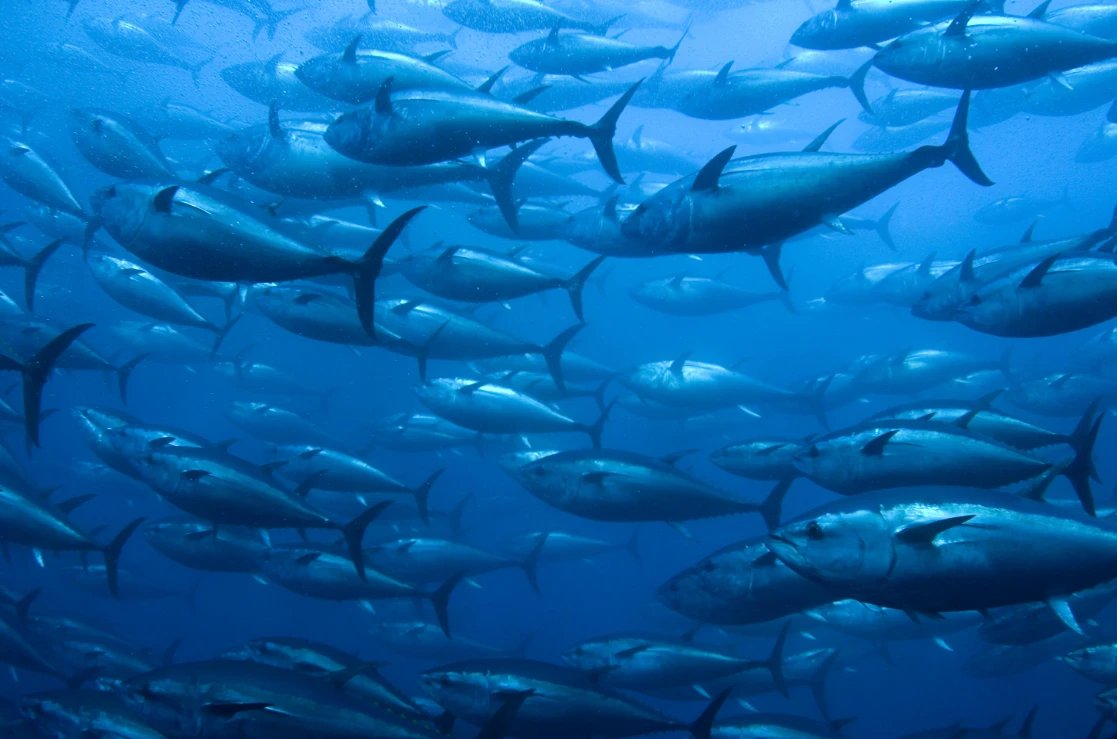
More than half of all the tuna caught on Earth comes out of one patch of ocean. In 2024, according to provisional figures presented to the Western and Central Pacific Fisheries Commission's scientific committee, the commission's area produced about 3 million tonnes, roughly 54% of the global tuna catch. The fish in that catch do not stay in any one country's waters. Skipjack, yellowfin and bigeye move between the exclusive economic zones of island states and the high seas, and are fished by fleets flying dozens of flags.
Pacific bluefin go further. They spawn in the western Pacific, around Japan and Taiwan, and tagging studies published in NOAA's Fishery Bulletin have followed juveniles crossing to the eastern Pacific in about two months, then spending years moving up and down the coast between Baja California and Oregon before returning west to breed. A fish caught off San Diego and a fish caught off Okinawa can belong to the same population.
No government can manage animals like that from its own coastline, so the job falls to regional fisheries management organisations. Five of them cover the world's commercial tuna: the Western and Central Pacific Fisheries Commission (WCPFC) and the Inter-American Tropical Tuna Commission (IATTC) in the Pacific, the International Commission for the Conservation of Atlantic Tunas, the Indian Ocean Tuna Commission, and the Commission for the Conservation of Southern Bluefin Tuna. Their members negotiate catch limits, closed seasons, gear rules and monitoring on the basis of stock assessments carried out by their scientists.
The tools are practical. In the eastern Pacific, IATTC members' purse seiners must stop fishing for a fixed period every year, set at 72 days for most of the past decade and trimmed to 64 days under the measures NOAA Fisheries is applying to US vessels from 2026, and the number of drifting fish aggregating devices (FADs) each vessel may deploy has been progressively cut. In the western Pacific, the eight Parties to the Nauru Agreement, whose waters supply around half the world's skipjack, run a vessel day scheme: they set a limited number of fishing days each year on scientific advice and sell them to fleets. The Pacific Islands Forum Fisheries Agency says fisheries make up 70–80% of government revenue in some member countries, which is why the islands defend the system so hard.
The results are hard to argue with. The International Seafood Sustainability Foundation, which tracks 23 major commercial tuna stocks, reported in January 2026 that 97% of the global commercial tuna catch now comes from stocks at healthy levels of abundance, up from 87% in March 2025. None of the 23 stocks was classed as overfished, and 96% were not subject to overfishing. FAO's State of World Fisheries and Aquaculture 2026 found that just over 91% of assessed tuna stocks were biologically sustainable, a far better record than marine fisheries as a whole.
Pacific bluefin shows what a commission can do when it acts. The stock was heavily fished for decades, much of it as juveniles, before the IATTC and the WCPFC's Northern Committee began managing it jointly through limits on catches. The 2024 stock assessment found that spawning biomass had passed the second rebuilding target of 20% of unfished levels in 2021 and stood at about 23% in 2022, a recovery the scientists attribute mainly to reduced fishing on fish aged three and under. The two commissions are now working on a management procedure that would set catch limits for small and large fish in the west and for the eastern Pacific under pre-agreed rules.
Healthy stocks are the foundation, not the whole building. ISSF counts only about 52% of the global tuna catch as coming from stocks with an adopted harvest strategy, the pre-agreed rules that tell managers how to adjust catches when the science changes. Without them every quota becomes a fresh negotiation. Pacific bluefin still has no formally agreed long-term biomass target, and conservation groups including WWF argued in 2024 that the rebuilding milestone was no reason to relax.
Stock status also says nothing about the sharks and turtles caught alongside tuna, the FADs that drift away and are lost, transhipment at sea that is hard to monitor, or working conditions on distant-water vessels. Those are the problems the next round of rules has to fix, and buyers can push for them through observer coverage and electronic monitoring requirements in their own supply contracts. As warming seas shift where tuna feed and spawn, the commissions will also have to settle who gets access to fish that move into new waters.
Tuna management is the clearest evidence there is that international fisheries cooperation works. In the 1990s and early 2000s, Atlantic, Pacific and southern bluefin were all pushed close to collapse. Today almost all of the world's tuna catch comes from healthy stocks, and that was achieved by slow, technical agreements between countries that often want different things. The remaining work, on harvest strategies, bycatch and labour, needs the same patience.
Fresh Catch · The SALT. newsletter
Enjoyed this story? There's more where that came from.
Food, oceans, people and ideas. The most interesting stories from SALT., delivered to your inbox.
Free to read. Free to subscribe. Unsubscribe anytime. Privacy
About this story · 10 sources
Sources
- ISSF, 97% of global tuna catch comes from stocks at healthy abundance levels (February 2026)
- MSC, Five takeaways from the FAO SOFIA report 2026
- Pew, Science-based fisheries management works, UN report shows
- WCPFC Scientific Committee SC21, overview of tuna fisheries in the western and central Pacific Ocean
- WCPFC, Pacific bluefin tuna (extended summary)
- Joint IATTC and WCPFC-NC working group on the management of Pacific bluefin tuna
- NOAA Fishery Bulletin, Itoh et al., migration of young Pacific bluefin tuna (2003)
- NOAA Fishery Bulletin, Domeier et al., tagging of Pacific bluefin tuna in the eastern Pacific (2005)
- NOAA Fisheries, Fishing restrictions for tropical tuna in the eastern Pacific Ocean, 2026 and beyond
- FFA Tuna Pacific, How Pacific Island nations built one of the world's largest sustainable tuna fisheries
Spotted an error? Tell us. We correct the record openly.